[ Architecture ] · 5 min read
What Qwen3.8-Flash-Next Tells You About Qwen4
Alibaba called Flash-Next an early preview of the architecture that will underpin Qwen4. The weights are public, so the preview is readable rather than promised.
Key takeaways
- Only one layer in four runs attention. The stack repeats 12 times: three Gated DeltaNet layers, then one Qwen Sparse Attention layer, 48 layers in total.
- Qwen Sparse Attention works on micro-blocks rather than tokens, with a budget of 512 blocks or 2,048 tokens. Qwen reports up to 10.2x prefill and 6.6x decode attention-kernel speedups at one million tokens.
- A 51B n-gram embedding table adds capacity without adding compute and can offload to host RAM, which is a scaling axis separate from both dense layers and mixture-of-experts.
- Qwen has not announced a Qwen4 date. Reports point to a launch soon after Qwen3.8, and Alibaba has confirmed only that Flash-Next previews the architecture.
Vendors preview an architecture with a blog post. Alibaba previewed Qwen4 by shipping 180 billion parameters of it under an open licence on 26 August 2026 and calling Qwen3.8-Flash-Next an early preview of the architecture that will underpin Qwen4. The design is readable from the config file rather than described in a roadmap.
Four changes stand out, and each one trades a familiar cost for a different one.
Three cheap layers for every expensive one
The stack repeats a four-layer block twelve times, for 48 layers. Three of the four run Gated DeltaNet, which carries a compressed summary of everything seen so far instead of comparing each token against every other one. The fourth runs Qwen Sparse Attention.
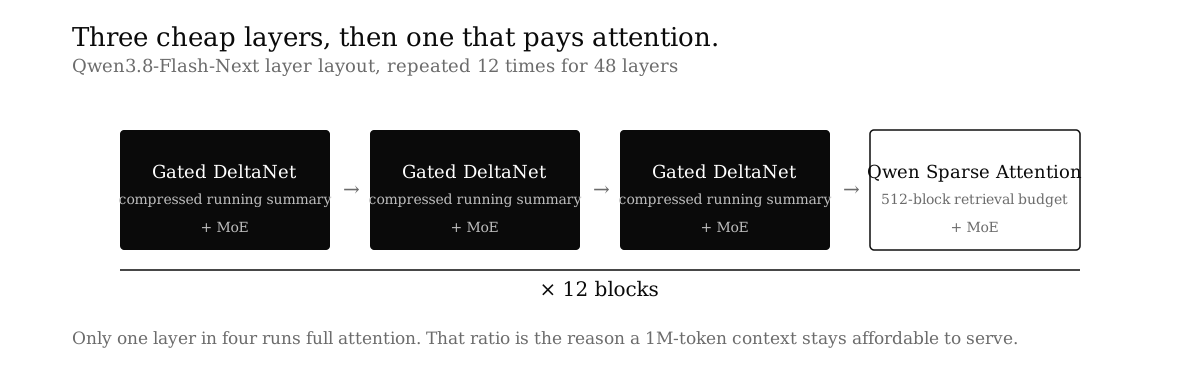
The change from previous Qwen releases is what sits in the fourth slot. Earlier hybrids paired Gated DeltaNet with gated attention. This pairs it with sparse attention that selects micro-blocks rather than individual tokens, on a budget of 512 blocks or 2,048 tokens. Selecting a block at a time cuts the bookkeeping that makes token-level sparse attention slow in practice.
Qwen reports the result as up to 10.2x prefill and 6.6x decode attention-kernel speedups at one million tokens. Those are vendor figures on vendor hardware, and they are the reason a 262,144-token native context extends to a million without the serving cost following.
Parameters that do not multiply anything
The n-gram embedding table is the least familiar piece. Flash-Next carries 20 million bigram and trigram entries at layer 2, totalling 51 billion parameters, alongside the 125B backbone. A lookup costs a memory read rather than a matrix multiplication, so those 51 billion parameters add capacity while adding close to no arithmetic per token.
They can also move off the accelerator. The vLLM implementation offloads the table to host RAM and prefetches the rows it needs, which turns 51 billion parameters into a system memory cost rather than a VRAM cost. We pulled that mechanism apart in the 51B lookup table.
The other two changes
| Change | What it does | What it means in deployment |
|---|---|---|
| Hybrid attention with QSA | Three Gated DeltaNet layers per sparse attention layer | Long context stays cheap to serve; needs a recent vLLM or SGLang build |
| Gated Residual | Four residual branches with read and write gates, bottleneck rank 320 | Deeper training stays stable; no operational change |
| N-gram embedding | 20M bigram and trigram entries, 51B parameters | 51 GB of host RAM if you offload it; no pipeline parallelism |
| Tailored training recipe | Muon and AdamW on different weight groups, no batch-size warmup | Training cost near one ninth of Qwen3.7-Plus |
The training recipe is the one with no deployment consequence and the largest strategic one. Qwen applies Muon and AdamW to different weight categories and starts at the target batch size instead of warming up to it, which cuts total optimizer steps. Alibaba puts the result at roughly one ninth the training cost of Qwen3.7-Plus. A lab that can train a frontier-adjacent model for a ninth of what the last one cost can ship more often.
What to test now
If the architecture carries into Qwen4, the work you do against Flash-Next transfers. Three things are worth checking against your own workload before the next release lands.
- Long-context behaviour past 262,144 tokens, where YaRN scaling takes over and Qwen advises evaluating shorter-context quality before making it the default.
- Whether your serving stack supports the layout. Pipeline parallelism does not work with the n-gram embedding layer in the initial release, and plain TP8 is incompatible with the FP8 checkpoint.
- Task shape. Flash-Next is stronger at editing existing code than authoring new repositories, which we measured in the one benchmark Qwen lost.
On timing, Alibaba has confirmed only that Flash-Next previews the Qwen4 architecture and that the release gives the community time to prepare. Reports point to Qwen4 following soon after Qwen3.8. Treat any specific date you read as unconfirmed until Qwen publishes one.
We track architecture releases because they change what AI automation costs to run, and a fourfold cut in attention cost reaches client budgets faster than a benchmark point does.
Frequently asked questions
When is Qwen4 coming out?
Alibaba has not announced a date. It has said Qwen3.8-Flash-Next previews the architecture that will underpin Qwen4 and that the early release lets developers prepare. Several reports suggest it follows soon after Qwen3.8, though Alibaba has confirmed nothing.
What is Qwen Sparse Attention?
An attention mechanism that selects micro-blocks of the sequence rather than individual tokens, on a budget of 512 blocks or 2,048 tokens. It runs in one layer out of every four in Flash-Next, with Gated DeltaNet in the other three.
What is Gated DeltaNet?
A linear attention variant that maintains a compressed running summary of the sequence instead of comparing every token against every other one. It costs far less at long context, and it pairs with a sparse attention layer that handles precise retrieval.
Will Qwen4 use the same architecture as Flash-Next?
Qwen describes Flash-Next as an early preview of the architecture that will underpin Qwen4, mirroring how Qwen3-Next previewed Qwen3.5. The final Qwen4 models could still differ, and Qwen has published no specification for them.
Related services
Related guides
Want a professional site without the agency invoice?
Tell us about your project below and we'll reply within 24 hours with a clear, fixed quote, no surprises.
Prefer WhatsApp or email?