[ Hardware ] · 5 min read
Qwen3.8-Flash-Next Needs 172.78 GiB to Run 6 Billion Parameters
Six billion active parameters sounds like a model you can run. The number that decides whether you can is 172.78 GiB, and it has nothing to do with how many parameters fire per token.
Key takeaways
- The FP8 checkpoint is 172.78 GiB and the BF16 checkpoint is 335.28 GiB. Both hold all 180B parameters, whatever the per-token activation count says.
- That works out to 28.8 GiB of VRAM per billion active parameters, against roughly 1.0 for a dense model. Flash-Next asks for about 29 times the memory per unit of compute it performs.
- Qwen carries 30 parameters on disk for every 1 it computes. DeepSeek-V4-Flash sits at 21.8 to 1, Qwen3.7-Plus at 23.4 to 1, and the dense Qwen3.8-27B at 1 to 1.
- On an 8x H200 node you must use TEP8. Plain TP8 is incompatible with the FP8 checkpoint's 128-wide quantization blocks, and offloading the n-gram table needs at least 51 GB of host RAM.
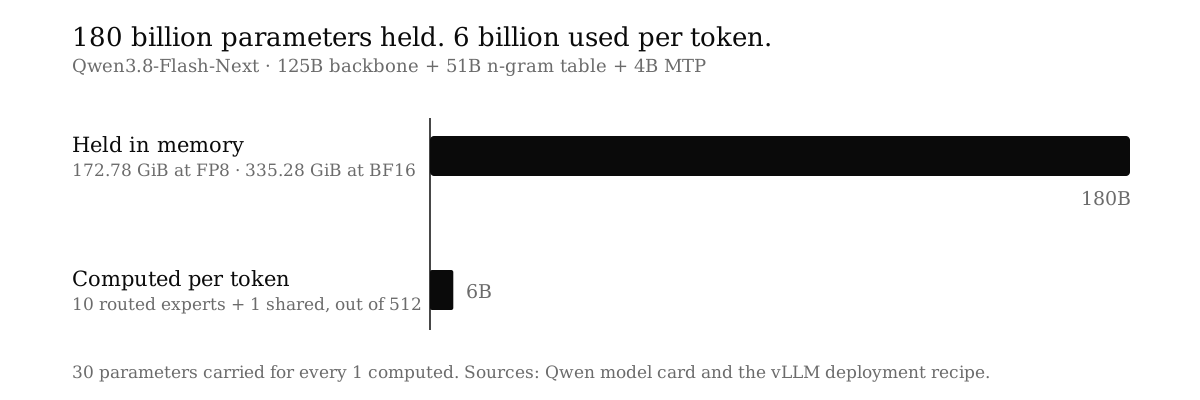
Qwen3.8-Flash-Next activates 6 billion parameters per token. That figure led every write-up of the launch, and it produced the same question across r/LocalLLM within hours: how much VRAM does it need? The answer is 172.78 GiB at FP8, or 335.28 GiB at BF16. Active parameter count does not reduce it.
Divide one by the other and you get the number worth keeping: 28.8 GiB of VRAM for every billion parameters the model computes with. A dense model sits near 1.0 on that measure. Sparsity buys speed and charges memory.
Why 6B active does not mean a 6B footprint
Flash-Next holds 512 experts. Each token routes to 10 of them plus one shared expert. Which 10 depends on the token, and the router can pick any of the 512 at any position. Every expert therefore sits in memory, ready, for a token that might never arrive.
The activation count describes arithmetic per token, which sets speed and price per token. Checkpoint size describes residency, which sets the hardware you need. Confusing the two is the most common mistake in reading a mixture-of-experts release, and framing the model around cost efficiency invites it.
A second layer compounds this. Alongside the 125B backbone, Flash-Next ships a 51B n-gram embedding table of 20 million bigram and trigram entries at layer 2, plus a 4B multi-token prediction module. Hugging Face lists the artifact as 180B parameters. The n-gram table can offload to host memory, which is the one place the design hands memory back.
How it compares to other sparse models
| Model | On disk | Active per token | Carried per computed |
|---|---|---|---|
| Qwen3.8-Flash-Next | 180B | 6B | 30.0 to 1 |
| Qwen3.7-Plus | 397B | 17B | 23.4 to 1 |
| DeepSeek-V4-Flash-0731 | 284B | 13B | 21.8 to 1 |
| Qwen3.8-27B | 27B | 27B | 1.0 to 1 |
Flash-Next is the sparsest model in the group Qwen chose to compare itself against. The achievement and the cost sit in the same row.
Configurations that work
The vLLM recipe published with the model lists validated deployments. Two of its notes will cost you an afternoon if you miss them.
| Hardware | Configuration | Note |
|---|---|---|
| GB300 | TP2, FP8 | Minimum validated FP8 deployment |
| GB300 | TP4, FP8 | Recommended full-tray configuration |
| 8x H200 | TEP8, FP8, Triton MoE backend | Plain TP8 is incompatible with the checkpoint |
| 4x MI355X | TP4, FP8, AITER on, AITER MoE off | The ROCm path |
| GB300 | TP2, BF16 | About 190 GiB per GPU |
The 8x H200 line is the trap. The FP8 checkpoint uses 128-wide quantization blocks, and plain tensor parallelism across 8 GPUs does not divide them. Use TEP8 with expert parallelism enabled. Pipeline parallelism fails too, because the n-gram embedding layer has no pipeline-parallel implementation in the initial release.
Offloading the n-gram table with VLLM_PLE_CPU_OFFLOAD=1 needs at least 51 GB of host RAM plus headroom, and the offload runs on NVIDIA devices only at present.
What the memory buys
Qwen reports its sparse attention reaching up to 10.2x prefill and 6.6x decode attention-kernel speedups at one million tokens, and 8.6x the prefill throughput of Qwen3.7-Plus at a 90% prefix-cache hit rate. The native context runs to 262,144 tokens, and YaRN extends it to a million. Those are vendor figures on vendor hardware, and they are the return on the memory bill.
For most businesses the arithmetic ends before it starts. Qwen Cloud serves the production version at $0.16 per million input tokens and $0.47 per million output tokens. Self-hosting has to beat that after hardware, power, and the engineer who keeps TEP8 running. We looked at the wider version of this question in why open weights is not a price.
One licence clause before you deploy it for a client
The licence is Qwen Community License 1.0, not Apache 2.0, whatever some launch coverage said. Internal use inside your own product carries no restriction. Operating a model-as-a-service or AI work assistant business on these weights requires a separate licence from Qwen. Agencies standing this up for a client should read that clause before quoting the work.
When we scope AI automation, hosted inference wins on cost for almost every client below serious volume. The models worth self-hosting are the ones small enough to sit on hardware you already own, and 172.78 GiB is not that.
Frequently asked questions
How much VRAM does Qwen3.8-Flash-Next need?
The FP8 checkpoint is 172.78 GiB and the BF16 checkpoint is 335.28 GiB. The minimum validated FP8 deployment is TP2 on GB300 hardware, with TP4 recommended. An 8x H200 node works with TEP8 but not plain TP8.
Can I run Qwen3.8-Flash-Next on a consumer GPU?
Not at FP8 or BF16. Community quantizations cut the footprint, and 60 variants are already published on Hugging Face, but a 180B model at 1-bit or 2-bit is a different model from the one Qwen benchmarked. Test the quantization you plan to ship.
Why does a 6B active model need so much memory?
It holds 512 experts and routes each token to 10 of them plus one shared expert. The router can pick any expert at any position, so all of them stay resident. Active parameters set arithmetic per token. Total parameters set memory.
Does the n-gram embedding table have to sit in VRAM?
No. The 51B n-gram table can offload to host memory with VLLM_PLE_CPU_OFFLOAD=1, which needs at least 51 GB of system RAM plus headroom. DEP requires the offload. TP and TEP treat it as optional.
Related services
Related guides
Want a professional site without the agency invoice?
Tell us about your project below and we'll reply within 24 hours with a clear, fixed quote, no surprises.
Prefer WhatsApp or email?