[ Comparison ] · 5 min read
Qwen3.8-Flash-Next vs DeepSeek V4-Flash: The One Coding Benchmark Qwen Lost
Qwen published the comparison table itself, and one row does not fit the launch story. The model that patches repositories better than DeepSeek writes them worse, by almost the same margin.
Key takeaways
- Qwen3.8-Flash-Next wins 9 of the 11 head-to-heads its own model card reports against DeepSeek-V4-Flash-0731, several by wide margins: CoWorkBench by 28.8 points, JobBench by 14.4.
- It loses NL2Repo-Bench 48.1 to 54.2. That is the only coding benchmark in the table it loses, and it measures generating a repository from a written specification.
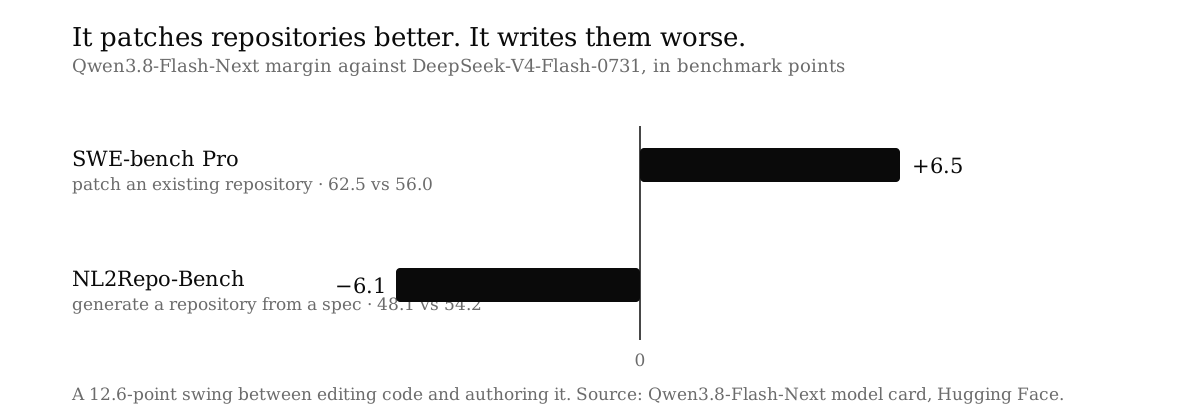
- On SWE-bench Pro it wins by 6.5 points (62.5 to 56.0), and that benchmark hands the model a repository that already exists. The distance between the two results is 12.6 points.
- The licence is Qwen Community License 1.0, not Apache 2.0. Running a model-as-a-service or AI work assistant business on it needs a separate licence from Qwen. Internal use does not.
Alibaba released Qwen3.8-Flash-Next on 26 August 2026 with open weights and a comparison table. Most coverage quoted the wins. Reading the table row by row, one number refuses to fit: on NL2Repo-Bench, Flash-Next scores 48.1 against DeepSeek-V4-Flash-0731's 54.2. It is the only coding benchmark in Qwen's own table where DeepSeek comes out ahead.
The benchmark above it tells the opposite story. On SWE-bench Pro, Flash-Next wins by 6.5 points. The two tests differ in one respect. SWE-bench Pro gives the model a repository that already exists and asks for a patch. NL2Repo-Bench gives it a description and asks for the repository. Qwen's model is 6.5 points better at the first job and 6.1 points worse at the second, a swing of 12.6 points across a single distinction.
The full head-to-head
Every figure below comes from the model card Qwen published with the weights. Qwen ran the baselines itself, so treat the whole table as a vendor's own evaluation. That cuts both ways. A vendor reporting a loss is the part you can trust most.
| Benchmark | What it measures | Flash-Next | DeepSeek V4-Flash | Margin |
|---|---|---|---|---|
| CoWorkBench | Long-horizon office work | 73.9 | 45.1 | +28.8 |
| JobBench | Professional job tasks | 55.7 | 41.3 | +14.4 |
| SWE-bench Pro | Patch an existing repo | 62.5 | 56.0 | +6.5 |
| DeepSWE 1.1 | Agentic coding | 58.7 | 54.4 | +4.3 |
| Toolathlon Verified | Real-world tool use | 73.5 | 70.3 | +3.2 |
| IFBench | Instruction following | 81.3 | 79.2 | +2.1 |
| HLE | Multidisciplinary reasoning | 35.9 | 33.8 | +2.1 |
| LiveCodeBench v6 | Competitive coding | 91.9 | 90.6 | +1.3 |
| GPQA Diamond | Scientific reasoning | 91.7 | 90.8 | +0.9 |
| Agents' Last Exam | Frontier agentic, Pass@1 | 24.3 | 25.2 | -0.9 |
| NL2Repo-Bench | Generate a repo from a spec | 48.1 | 54.2 | -6.1 |
Nine wins, two losses. Margins on the wins run from 0.9 points to 28.8, and the CoWorkBench result is wide enough to read as a category difference rather than a ranking. On long-horizon office work, DeepSeek scores 45.1 and Qwen scores 73.9.
The two benchmarks are not testing the same skill
SWE-bench Pro starts from a repository with a failing test and a bug report. The model reads code someone else wrote, finds the fault, and edits a small number of lines. Success depends on reading comprehension over a large codebase and on restraint, since a patch that changes too much breaks the other tests.
NL2Repo-Bench starts from a paragraph. The model chooses the file layout, the module boundaries, the dependencies and the interfaces, then writes all of it. Nothing constrains the answer except the specification. Success depends on holding a design in mind across thousands of tokens of generation without contradicting a decision it made earlier.
Qwen's architecture suggests a reason for the split. Three of every four layers use Gated DeltaNet, which keeps a compressed running summary of what came before rather than attending to every token. The fourth layer runs Qwen Sparse Attention with a budget of 512 blocks. That design retrieves well from a long input, which is what patching needs. Reconstructing a decision from 4,000 tokens back in the model's own output is a different demand, and a compressed summary is a lossier place to keep it.
Treat that as a reading of the numbers rather than a proof. Qwen has published no ablation isolating the cause, and the technical report is where one would appear.
What this changes about where you point it
Most production agent work is editing. A support agent updates a record. A migration agent rewrites configuration files that already exist. A maintenance agent fixes a failing build. On that shape of work Flash-Next beats a model with more than twice its total parameters, and it costs $0.16 per million input tokens and $0.47 per million output tokens through Qwen Cloud.
Greenfield generation is where the number turns. If you are asking a model to stand up a new service from a brief, DeepSeek-V4-Flash resolved 6.1 more points of that benchmark. One benchmark is not your codebase, so run both against twenty tickets from your own backlog before committing. We have written before about why cost per solved task beats cost per token, and the logic holds here too: a model that is cheaper per token and needs three attempts is not cheaper.
The licence line most coverage got wrong
Several outlets reported the release as Apache 2.0. The LICENSE file on the Hugging Face repository says Qwen Community License 1.0. Two clauses decide what you can sell. Products above 100 million monthly active users or $20 million in monthly revenue must display the model name in the interface. More relevant for smaller teams: anyone operating a model-as-a-service or AI work assistant business has to obtain a separate licence from Qwen before using the weights for any commercial purpose.
Internal use carries no such restriction. Run the model inside your own product to serve your own users and you are fine. Sell access to the model itself and you need to read the licence first.
How we would use it
- Point it at maintenance and refactor work, where the SWE-bench Pro and DeepSWE results are strongest and the repository already exists.
- Keep a second model for greenfield builds until you have tested NL2Repo-style work on your own code.
- Measure cost per completed ticket rather than cost per token, since retries are where the savings disappear.
- Check the licence first if you resell model access rather than using it inside your own product.
We build AI agents and automation on whichever model wins on the client's actual tickets, and that answer changes every few months. Flash-Next moved it for maintenance work. It left greenfield where it was.
Frequently asked questions
Is Qwen3.8-Flash-Next better than DeepSeek V4-Flash?
On Qwen's own published table it wins 9 of 11 head-to-head benchmarks, including SWE-bench Pro by 6.5 points and CoWorkBench by 28.8. It loses NL2Repo-Bench by 6.1 points and Agents' Last Exam Pass@1 by 0.9. For patching existing code it is ahead. For generating a whole repository from a specification, DeepSeek scored higher.
What is NL2Repo-Bench?
A repository-level code generation benchmark. The model receives a natural-language specification and has to produce a working repository, choosing the file layout, dependencies and interfaces itself. Qwen evaluated it with the Claude Code harness and disabled Bash commands like pip install and git clone to stop models fetching the answer.
Related services
Related guides
Want a professional site without the agency invoice?
Tell us about your project below and we'll reply within 24 hours with a clear, fixed quote, no surprises.
Prefer WhatsApp or email?