[ Comparison ] · 5 min read
Qwen3.8-27B vs Flash-Next: 0.8 Points Apart on Code, 153B Parameters Apart on Disk
Qwen put both models in the same table, and the pattern in the margins is sharper than the headline. Where the task runs long, Flash-Next pulls away. Where it does not, the dense 27B is within a point.
Key takeaways
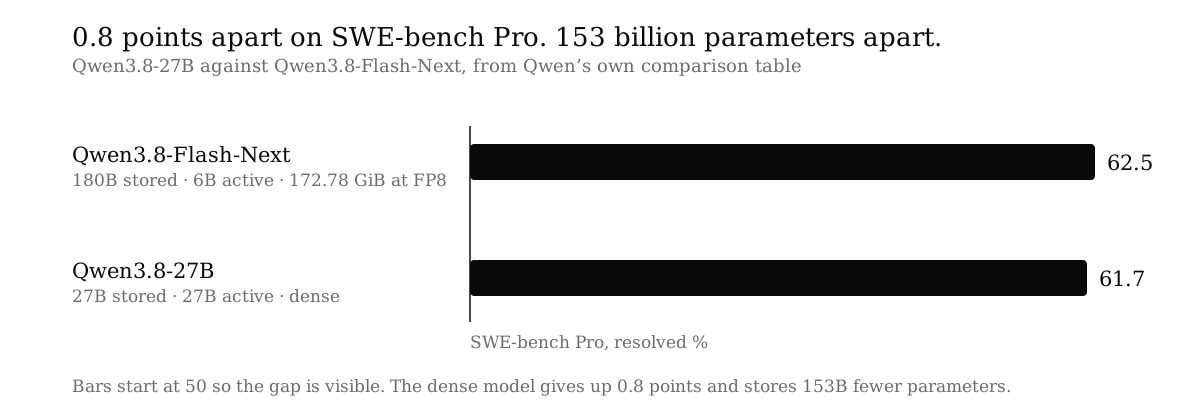
- On SWE-bench Pro the two models are 0.8 points apart, 62.5 against 61.7, while Flash-Next stores 153 billion more parameters.
- Flash-Next's average margin on long-horizon agentic benchmarks is +12.1 points. On single-shot benchmarks it is +1.7. The gain is 7.2 times larger where the task runs long.
- The widest gaps are JobBench at +22.3 and DeepSWE 1.1 at +16.5. The narrowest are SWE-bench Pro at +0.8 and LiveCodeBench v6 at +1.6.
- The dense 27B fits hardware Flash-Next does not. 27B stored against 180B, and Flash-Next needs 172.78 GiB at FP8 before you serve a single token.
- The two models ship under different licences. Qwen3.8-27B is Apache 2.0. Flash-Next is Qwen Community License 1.0, which needs a separate agreement from Qwen for model-as-a-service or AI work assistant businesses at any revenue.
Qwen shipped Qwen3.8-27B two weeks before Qwen3.8-Flash-Next and put both in the same comparison table. The headline reads as a straight upgrade: Flash-Next wins all eleven language benchmarks. Sorting those wins by margin tells you something the headline does not.
On SWE-bench Pro the models are 0.8 points apart. On JobBench they are 22.3 points apart. Both are Qwen's own numbers, run on the same harness. The spread between those two results is the useful part of this release.
Sorted by margin, the pattern appears
| Benchmark | Type | Flash-Next | 27B | Margin |
|---|---|---|---|---|
| JobBench | Agentic | 55.7 | 33.4 | +22.3 |
| DeepSWE 1.1 | Agentic | 58.7 | 42.2 | +16.5 |
| SWE-bench Multilingual | Single-shot | 81.0 | 73.8 | +7.2 |
| Toolathlon Verified | Agentic | 73.5 | 67.1 | +6.4 |
| NL2Repo-Bench | Single-shot | 48.1 | 42.3 | +5.8 |
| HLE | Single-shot | 35.9 | 30.8 | +5.1 |
| CoWorkBench | Agentic | 73.9 | 70.7 | +3.2 |
| GPQA Diamond | Single-shot | 91.7 | 89.2 | +2.5 |
| IFBench | Single-shot | 81.3 | 79.5 | +1.8 |
| LiveCodeBench v6 | Single-shot | 91.9 | 90.3 | +1.6 |
| SWE-bench Pro | Single-shot | 62.5 | 61.7 | +0.8 |
Take the four benchmarks that run a model through many turns of tool use, and the four that ask it one hard question. Flash-Next averages +12.1 points on the agentic set and +1.7 on the single-shot set. The architecture pays 7.2 times more where the task runs long.
Why long tasks are where it shows
Flash-Next holds 512 experts and routes each token to 10 of them. A long agent run touches many kinds of work: reading a schema, calling a tool, parsing an error, writing a patch, checking the result. Different experts serve each of those, and a model with 512 to choose from has more room to specialise than a dense 27B applying the same weights to every token.
A single hard coding question exercises one kind of competence for a few hundred tokens. Routing helps less. That is one reading of the margins, and Qwen has published no ablation confirming it, so treat it as provisional.
The hardware decides most of this anyway
| Qwen3.8-27B | Qwen3.8-Flash-Next | |
|---|---|---|
| Parameters stored | 27B | 180B |
| Active per token | 27B (dense) | 6B |
| FP8 checkpoint | not published | 172.78 GiB |
| Minimum validated deployment | single accelerator class | TP2 on GB300 |
| Fits a workstation | Yes, quantized | No |
For a team running models on hardware it owns, the comparison stops here. A 27B dense model quantizes onto a workstation. A 180B checkpoint needs a node. Flash-Next earns its 0.8-point edge on SWE-bench Pro only if you were going to rent that node regardless.
Through an API the calculation reverses, since you pay per token and someone else buys the GPUs. Qwen Cloud lists the production Flash tier at $0.16 and $0.47 per million tokens, and at that price the agentic margin is worth having. We covered why the download-versus-API question has a clear answer in why open weights is not a price.
Which one to pick
- Long-running agents that call tools across many turns: Flash-Next, by an average of 12.1 points on those benchmarks.
- Code completion, review and single-shot generation: the 27B is within 1.6 points on both coding benchmarks and fits far smaller hardware.
- Self-hosting on hardware you already own: the 27B, since 172.78 GiB rules the other one out.
- Buying tokens from an API: Flash-Next, because the memory cost is not yours and the agentic margin is.
The licences differ, and that matters more than a point of benchmark score. Qwen3.8-27B ships under Apache 2.0. Flash-Next ships under Qwen Community License 1.0, whose second condition requires anyone running a model-as-a-service or AI work assistant business to obtain a separate licence from Qwen, with no revenue threshold attached. If you sell a coding assistant or resell inference, the dense model is the one you can build on without a conversation with Alibaba.
Alibaba split the Qwen3.8 family across licences by tier. The permissive licence sits on the smaller model and the conditional one sits on the models you would most want to sell access to. We pulled that apart in what the Qwen licence means if you sell AI.
When we scope AI agents, the question is never which model scores highest. It is which model clears the bar on the client's tasks at the lowest total cost, and for short tasks that is often a smaller model than the launch coverage suggests.
Frequently asked questions
Is Qwen3.8-Flash-Next better than Qwen3.8-27B?
On all eleven language benchmarks Qwen reports for both, yes. The margin swings from +22.3 points on JobBench to +0.8 on SWE-bench Pro. It averages +12.1 on long-horizon agentic benchmarks and +1.7 on single-shot ones.
Can I run Qwen3.8-27B locally?
A 27B dense model quantizes onto a high-end workstation, which is why it remains popular for local use. Flash-Next stores 180B parameters and needs 172.78 GiB at FP8, so it needs server hardware.
Why is the dense 27B so close on coding benchmarks?
Single-shot coding exercises one competence for a few hundred tokens, where a mixture-of-experts router has less to gain. The 27B applies all 27B of its parameters to every token, while Flash-Next applies 6B. On short focused tasks that trade is close to even.
Which model should an agency deploy for a client?
For tool-calling agents that run many turns, Flash-Next through an API. For code assistance and review, the 27B is within about a point, cheaper to host, and released under Apache 2.0. Flash-Next uses Qwen Community License 1.0, which requires a separate agreement for model-as-a-service and AI work assistant businesses at any size.
Related services
Related guides
Want a professional site without the agency invoice?
Tell us about your project below and we'll reply within 24 hours with a clear, fixed quote, no surprises.
Prefer WhatsApp or email?