[ Architecture ] · 4 min read
The 51B Lookup Table: Parameters That Cost Almost No Compute
Dense layers multiply. Experts route. A lookup table does neither, which is why Qwen could add 51 billion parameters to a model that computes with six.
Key takeaways
- Qwen3.8-Flash-Next holds a 20,000,000-entry bigram and trigram table at layer 2, totalling 51 billion parameters next to a 125B backbone.
- A lookup is a memory read, not a matrix multiply. Those 51B parameters add capacity while adding close to no arithmetic per token.
- The table can offload to host RAM, which converts 51B parameters from a VRAM cost into a system memory cost of at least 51 GB.
- It rules out pipeline parallelism. The n-gram embedding layer has no pipeline-parallel implementation in the initial release, so single-node tensor or expert parallelism is the only path.
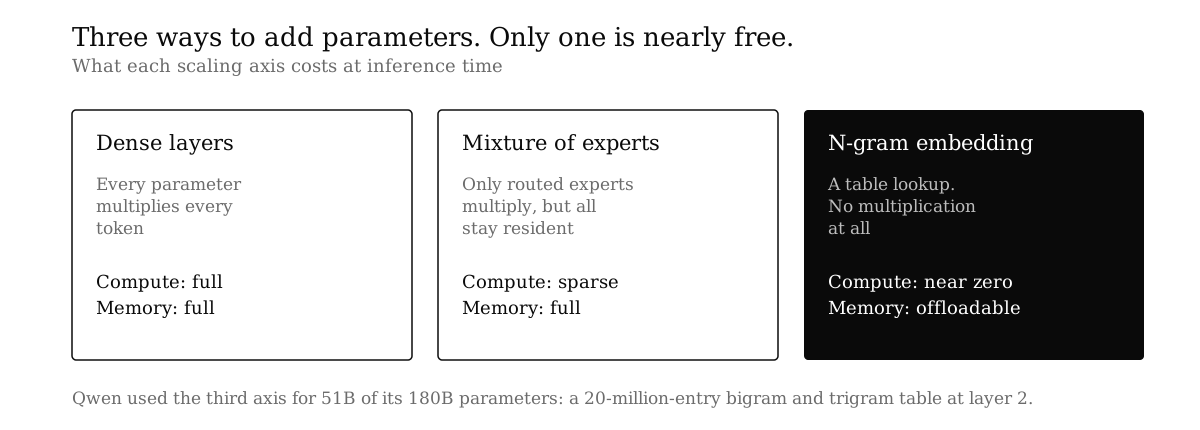
There are two familiar ways to make a language model bigger. Add dense layers, and every added parameter multiplies against every token. Add experts, and only the routed ones multiply while all of them sit in memory. Qwen3.8-Flash-Next uses a third way for 51 of its 180 billion parameters, and it behaves unlike either.
What the table holds
Qwen indexes 20 million bigrams and trigrams, pairs and triples of adjacent tokens, and gives each one a learned vector. The table sits at layer 2, near the bottom of a 48-layer stack. When a token arrives, the model looks up the entries for the short sequences ending at that position and injects them into the residual stream.
The operation is an array index. It multiplies nothing. A dense layer with 51 billion parameters would add 51 billion multiply-accumulate operations for every token; the table adds a handful of memory reads. That difference is the whole reason the model can hold 180 billion parameters while computing with six.
Why a lookup earns its place
Language contains a large amount of information that is local and fixed. Which word follows another in a common phrase, and which token pairs never co-occur. Storing those facts in weights that participate in every matrix multiplication is expensive, and a table can hold them at the cost of the memory they occupy.
Qwen frames it as an axis for parameter scaling that needs less computation and takes to offloading better than mixture-of-experts. Offloading is the part that changes your hardware bill: the vLLM implementation keeps the table in host RAM and prefetches the rows the model needs, so 51 billion parameters stop competing for accelerator memory.
The three axes compared
| Axis | Compute per token | Memory | Can it offload? |
|---|---|---|---|
| Dense layers | Every parameter multiplies | Full, resident | No |
| Mixture of experts | Only routed experts multiply | Full, resident | Poorly |
| N-gram embedding | A lookup, no multiplication | Full, but movable | Yes, to host RAM |
Flash-Next uses all three. 125 billion parameters across 512 experts with 10 routed per token, 51 billion in the n-gram table, and 4 billion in a multi-token prediction module for speculative decoding.
What it costs you
Two constraints follow from the table, and both appear in the official vLLM recipe.
- Offloading needs at least 51 GB of host RAM plus headroom, and the offload path runs on NVIDIA devices only in the initial release.
- Pipeline parallelism does not work. The n-gram embedding layer has no pipeline-parallel implementation yet, so single-node tensor or expert parallelism is the only supported route.
Neither is fatal, and both are the sort of constraint that turns a weekend deployment into a week. If you are sizing hardware rather than reading architecture papers, the number that decides it is the 172.78 GiB FP8 checkpoint, covered in what 6B active costs in VRAM.
Whether this spreads
Qwen describes Flash-Next as a preview of the Qwen4 architecture, so the table is likely to appear again in the next family rather than being a one-off experiment. Whether other labs adopt it depends on results nobody outside Alibaba has yet, since the technique arrived with the model and not with an ablation study separating its contribution from the other three changes.
For anyone building on top rather than training from scratch, the practical effect is narrow and real: a model that reads like a 180B and serves like a 6B, provided your hardware can hold it. We wrote up the rest of the preview in what Flash-Next tells you about Qwen4.
Frequently asked questions
What is n-gram embedding in a language model?
A lookup table that maps short sequences of adjacent tokens, such as pairs and triples, to learned vectors. Qwen3.8-Flash-Next holds 20 million such entries at layer 2, totalling 51 billion parameters. Reading from it costs a memory access rather than a matrix multiplication.
Why does n-gram embedding not slow the model down?
Because a lookup is an array index. A dense layer of the same size would add 51 billion multiply-accumulate operations per token. The table adds a small number of memory reads, so it grows capacity without growing arithmetic.
Can the n-gram table be offloaded from GPU memory?
Yes. The vLLM implementation offloads it to host memory and prefetches the rows it needs in the background, requiring at least 51 GB of system RAM plus headroom. DEP requires the offload. Tensor and expert parallelism treat it as optional.
Is n-gram embedding the same as mixture of experts?
No. Mixture of experts routes each token to a subset of expert networks that still perform matrix multiplications. An n-gram table performs no multiplication at all, and unlike experts it offloads to host memory without penalty.
Related services
Related guides
Want a professional site without the agency invoice?
Tell us about your project below and we'll reply within 24 hours with a clear, fixed quote, no surprises.
Prefer WhatsApp or email?