[ Decision ] · 5 min read
Should You Move a Production Agent to a Cheaper Model?
Every few weeks a model launches that undercuts what you are running. Four measurements tell you whether the switch is worth the migration, and you can run them in an afternoon.
Key takeaways
- Task shape decides more than price. Qwen3.8-Flash-Next beats DeepSeek-V4-Flash by 6.5 points at patching existing repositories and loses by 6.1 at generating new ones.
- Output share sets the size of any price win. The gap against GPT-5.6 Luna runs from 1.25x at pure retrieval to 2.55x at pure generation.
- Caching can reverse the ranking. With a 90% cache-hit rate, Luna is cheaper than Qwen below a 14.3% output share.
- A licence can end the evaluation before benchmarks start. Qwen Community License 1.0 requires a separate agreement for model-as-a-service and AI work assistant businesses at any size.
A model launched yesterday that costs less than the one running your agent. That happens about once a month now, and each time somebody proposes a migration on the strength of a price table. Most of those migrations should not happen, and you can identify the ones that should in an afternoon.
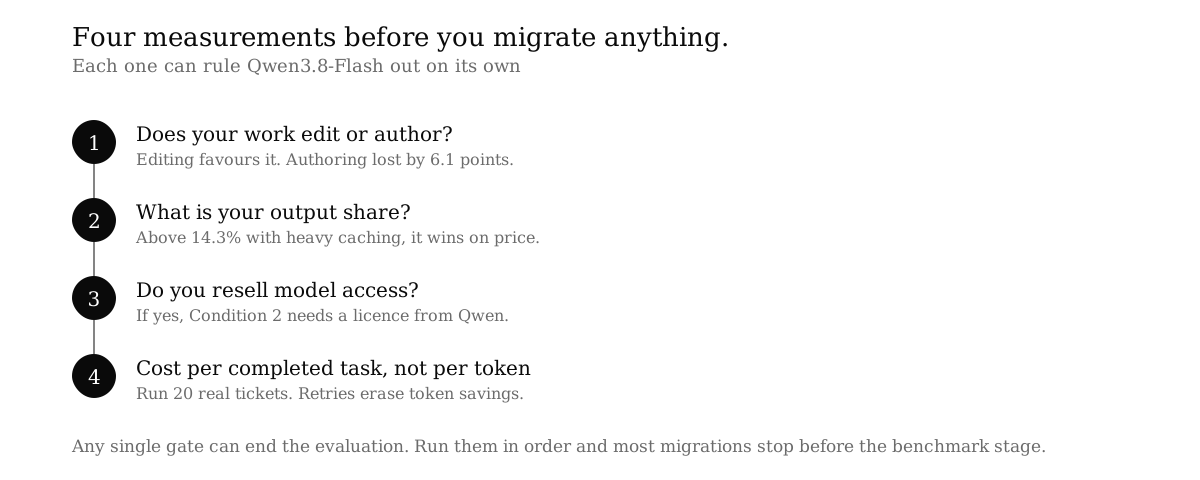
Four measurements, in order. Any one of them can end the evaluation, and running them in this order means most evaluations stop before the expensive stage.
Gate 1: does your agent edit or author?
Benchmark averages hide this and it matters more than any other capability question. Qwen3.8-Flash-Next scores 62.5 on SWE-bench Pro, which hands a model an existing repository and asks for a patch, against DeepSeek-V4-Flash at 56.0. On NL2Repo-Bench, which asks for a repository built from a written specification, it scores 48.1 against DeepSeek at 54.2.
Same two models, opposite results, 12.6 points between them. Sort your agent's work into editing and authoring before reading any leaderboard, because the leaderboard averages the two together.
Gate 2: what share of your tokens does the model write?
Take a week of production traffic and divide output tokens by total tokens billed. Most teams guess this number and guess high. Classification and routing sit near 2%. Support chat sits near 20%. Long-form drafting runs past 60%.
| Output share | Qwen3.8-Flash | GPT-5.6 Luna | Gap |
|---|---|---|---|
| 0% | $0.1600 | $0.2000 | 1.25x |
| 10% | $0.1910 | $0.3000 | 1.57x |
| 25% | $0.2375 | $0.4500 | 1.89x |
| 50% | $0.3150 | $0.7000 | 2.22x |
| 100% | $0.4700 | $1.2000 | 2.55x |
Then check your cache-hit rate, because it can invert the answer. Luna prices cached input at $0.02 per million tokens. At a 90% cache-hit rate it beats Qwen below a 14.3% output share and loses above it. We worked that crossover through in Qwen3.8-Flash vs GPT-5.6 Luna.
Gate 3: does the licence permit what you sell?
This gate costs nothing to check and ends more evaluations than the benchmark work does. Qwen3.8-Flash-Next ships under Qwen Community License 1.0, whose second condition requires any model-as-a-service or AI work assistant business to obtain a separate licence from Qwen. No revenue threshold applies.
If you sell access to the model, or sell a standalone coding or office productivity product, read the licence before the benchmark. Qwen3.8-27B ships under Apache 2.0 and clears this gate outright. The full breakdown is here.
Gate 4: cost per completed task
Price per token describes one attempt. Your bill is attempts multiplied by price, and a model that fails more often costs more while looking cheaper. Take twenty real tickets from your backlog, run both models, and count completions rather than tokens.
Twenty is enough to catch a large difference and too few to settle a small one. If the two models land within a few percentage points, the migration is not worth the engineering time, and the argument for that is in cost per token is the wrong metric.
If all four gates pass
- Move one workload rather than the system. Pick the one with the highest volume and the least business risk.
- Keep the previous provider configured behind a flag for a fortnight. Model launches get withdrawn and rate limits change.
- Re-run your evaluation set rather than trusting the vendor table, since the vendor selling the model ran every published benchmark.
- Log cost per completed task from day one, because the number that justified the migration is the number that has to hold.
We run this on client systems every time a launch makes the case, and most of the time the answer is to stay. When we build AI agents the provider is a configuration value rather than a commitment, which is what makes the question cheap to answer each time it comes up.
Frequently asked questions
How do I know if switching LLM provider is worth it?
Check four things in order: whether your workload edits or authors, what share of your tokens the model writes, whether the licence permits what you sell, and cost per completed task on twenty real jobs. Any one of them can rule out the migration, and the licence check is free.
Is a cheaper model per token always cheaper overall?
No. Your bill is attempts multiplied by price per attempt. A model that costs 40% less and needs a second attempt on a fifth of your tasks can cost more than the model it replaced. Measure completions, not tokens.
How many test cases do I need to compare two models?
Twenty real tasks from your own backlog will reveal a large difference. It will not settle a small one. If two models land within a few percentage points on twenty tasks, treat them as equivalent and keep the one you have already integrated.
What should I keep in place after migrating?
Keep the previous provider configured behind a feature flag for at least two weeks, keep your evaluation set runnable on demand, and log cost per completed task rather than token spend so you can tell whether the saving that justified the move arrived.
Related services
Related guides
Want a professional site without the agency invoice?
Tell us about your project below and we'll reply within 24 hours with a clear, fixed quote, no surprises.
Prefer WhatsApp or email?