[ Capability ] · 6 min read
Where the Cheap Model Tier Stops Working
Price tables tell you what a model costs. They cannot tell you the thing you need, which is whether the cheap one clears the bar on your work. Qwen published enough data to answer it.
Key takeaways
- On the three best-specified benchmarks, four models land within 2.5 points of each other. A model computing with 6B active parameters ties one computing with 17B. Buying more capability changes nothing here.
- On agentic benchmarks the spread reaches 42.2 points. DeepSWE 1.1 runs from 16.5 to 58.7 across the same four models. This is the only zone where model choice pays.
- No model in the group clears 36 on open-ended work. The best Agents' Last Exam Pass@1 is 25.2, so the leader fails roughly three attempts in four.
- The worst benchmark is the same one for all four models. Task shape sets the ceiling, and price does not move it.
Every model launch produces a price table and a leaderboard, and neither answers the question you have. You want to know whether the cheap model clears the bar on your work. Qwen published four models against eleven benchmarks in one table, which is enough data to answer it.
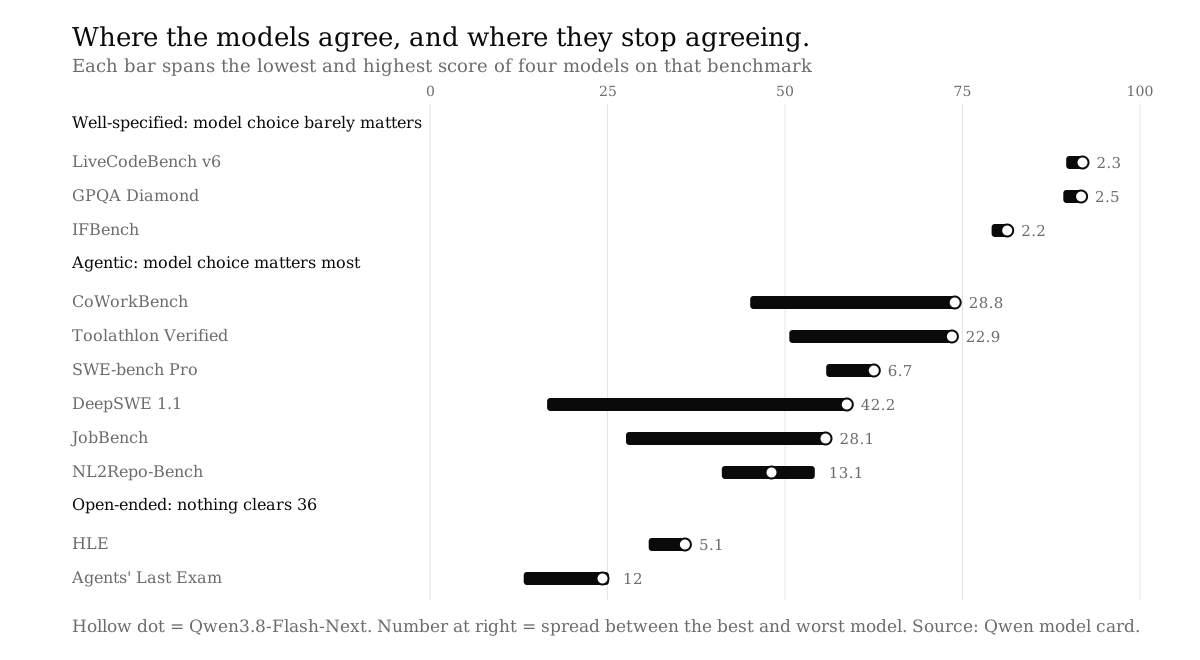
Sort those benchmarks by score and the models fall into three zones. In one of them the cheap model ties the expensive one. In another the gap runs to 42 points. In the third every model fails.
Zone one: the models converge
On LiveCodeBench v6, GPQA Diamond and IFBench, the four models sit within 2.3, 2.5 and 2.2 points of each other. Those benchmarks share a property. Each question has a defined answer, the input fits in a short context, and success takes one pass.
| Benchmark | Flash-Next (6B active) | Qwen3.7-Plus (17B active) | Spread across four models |
|---|---|---|---|
| LiveCodeBench v6 | 91.9 | 89.6 | 2.3 |
| GPQA Diamond | 91.7 | 90.3 | 2.5 |
| IFBench | 81.3 | 79.1 | 2.2 |
A model activating 6 billion parameters beats one activating 17 billion on all three. If your workload lives here, classification, extraction, structured output, bounded questions with a known answer, then paying for a stronger model buys you noise. Pick on price and latency.
Zone two: where the money goes
The middle of the table breaks that pattern. DeepSWE 1.1 runs from 16.5 to 58.7 across the same four models, a spread of 42.2 points. CoWorkBench spans 28.8 points and JobBench 28.1.
| Benchmark | Weakest | Strongest | Spread |
|---|---|---|---|
| DeepSWE 1.1 | 16.5 | 58.7 | 42.2 |
| CoWorkBench | 45.1 | 73.9 | 28.8 |
| JobBench | 27.6 | 55.7 | 28.1 |
| Toolathlon Verified | 50.6 | 73.5 | 22.9 |
| NL2Repo-Bench | 41.1 | 54.2 | 13.1 |
| SWE-bench Pro | 55.8 | 62.5 | 6.7 |
These benchmarks run a model through many turns. It reads a schema, calls a tool, parses an error, tries again. Small differences in reliability compound over a long run, so a model two points better per step lands far ahead by the end. This zone repays a real evaluation, because the choice is worth 20 points or more.
Note where SWE-bench Pro falls. At a 6.7-point spread it behaves more like zone one than zone two, which is why the cheap tier handles code maintenance well. We took that apart in the one benchmark Qwen lost.
Zone three: nobody is close
At the bottom, HLE tops out at 35.9 and Agents' Last Exam Pass@1 tops out at 25.2. The strongest model in Qwen's comparison fails roughly three of every four attempts on the second one.
Both benchmarks ask open-ended questions with no fixed shape. Buying a larger model moves the number by a few points and leaves the failure rate where it was. If your plan depends on an agent handling open problems without supervision, no price tier available in August 2026 supports it.
The pattern holds across every model
Each of the four models scores its best on LiveCodeBench or GPQA and its worst on Agents' Last Exam. The ordering of benchmarks stays the same whether the model activates 6 billion parameters or 17 billion.
| Model | Active params | Best score | Worst score | Spread |
|---|---|---|---|---|
| Qwen3.8-Flash-Next | 6B | 91.9 | 24.3 | 67.6 |
| Qwen3.8-27B | 27B | 90.3 | 20.4 | 69.9 |
| DeepSeek-V4-Flash-0731 | 13B | 90.8 | 25.2 | 65.6 |
| Qwen3.7-Plus | 17B | 90.3 | 13.2 | 77.1 |
Every model swings between 65 and 77 points depending on what you ask. That range dwarfs the gap between the models, which reaches 2.5 points at the top of the table. Task shape sets your result. Model choice adjusts it.
How to use this
- Sort your workload into the three zones before you compare prices. Most business work sits in zone one, where the cheapest capable model wins.
- Spend your evaluation effort on zone two, since that is where 20 to 40 points hang on the choice.
- Treat zone three as a design problem. Narrow the task until it moves into zone two, or keep a person in the loop.
One caveat on all of it. Qwen ran these numbers and picked the comparison set, which is normal and worth remembering. The zones are a way to read the shape of the data rather than a measurement of your workload. Twenty tasks from your own backlog will tell you more than any published table, and the method for that is in cost per token is the wrong metric.
Most of the AI automation work clients bring us sits in zone one, which is why our answer is so often a smaller model than they expected to buy.
Frequently asked questions
When should I use a cheaper LLM?
For well-specified work with a defined answer, such as classification, extraction, structured output and bounded questions. On those benchmarks four models spanning 6B to 27B activated parameters land within 2.5 points of each other, so the extra spend buys nothing measurable.
When is a cheaper model a mistake?
On long-horizon agentic work. Across the same four models, DeepSWE 1.1 scores range from 16.5 to 58.7, a spread of 42.2 points. Reliability differences compound across many turns, so model choice matters most where the task runs longest.
Is Qwen3.8-Flash good enough for production?
For well-specified tasks it matches or beats models with more active parameters, scoring 91.9 on LiveCodeBench v6 and 91.7 on GPQA Diamond. For open-ended agentic work it scores 24.3 Pass@1 on Agents' Last Exam, and no model in Qwen's comparison does better than 25.2.
Does paying more for a model fix a hard task?
Not on open-ended problems. The best score in this group on Agents' Last Exam is 25.2 Pass@1, meaning the leader fails about three attempts in four. Narrowing the task moves the result far more than upgrading the model does.
Related services
Related guides
Want a professional site without the agency invoice?
Tell us about your project below and we'll reply within 24 hours with a clear, fixed quote, no surprises.
Prefer WhatsApp or email?