[ Pricing ] · 5 min read
Qwen3.8-Flash vs GPT-5.6 Luna: The Output Token Decides It
Two budget-tier models, 25% apart on input and 155% apart on output. Which one is cheaper depends on a ratio most teams have never measured for their own workload.
Key takeaways
- Input prices are close: $0.16 for Qwen3.8-Flash against $0.20 for GPT-5.6 Luna, a gap of 25%. Output prices are not: $0.47 against $1.20, a gap of 155%.
- Luna charges 6.0x its input price for output. Qwen charges 2.94x. The more your workload generates, the wider the gap between the two bills.
- Luna publishes a cached input price of $0.02, ten times cheaper than Qwen's uncached input. Qwen has published no cache-hit rate for Flash.
- At a 90% cache-hit rate, Luna is cheaper than Qwen below a 14.3% output share and more expensive above it. That line is the whole decision for cache-heavy workloads.
Alibaba announced Qwen3.8-Flash at $0.16 per million input tokens and $0.47 per million output tokens. OpenAI lists GPT-5.6 Luna at $0.20 input and $1.20 output. Comparing the headline numbers gives you two answers depending on which column you read, and teams pick whichever column suits the pitch.
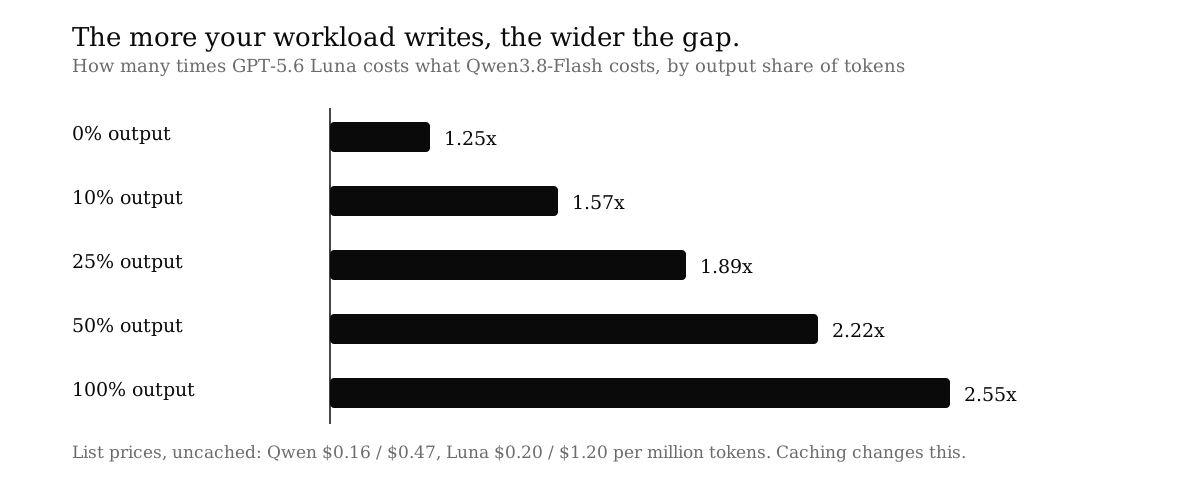
The honest comparison needs one number about your own system: what share of the tokens you pay for are tokens the model wrote. Classification and routing sit near 2%. Chat sits somewhere near 20%. Long-form generation runs past 60%. That ratio moves the price gap between these two models from 1.25x to 2.55x.
The list prices
| Model | Input | Cached input | Output | Output as a multiple of input |
|---|---|---|---|---|
| Qwen3.8-Flash | $0.16 | not published | $0.47 | 2.94x |
| GPT-5.6 Luna | $0.20 | $0.02 | $1.20 | 6.00x |
That last column is the structural difference. OpenAI prices Luna as a cheap way to read and an expensive way to write. Alibaba prices Flash closer to flat. Two models can share a tier and still suit opposite workloads.
Blended cost, by how much your system writes
| Output share | Qwen3.8-Flash | GPT-5.6 Luna | Luna as a multiple |
|---|---|---|---|
| 0% (pure retrieval) | $0.1600 | $0.2000 | 1.25x |
| 10% (classification, routing) | $0.1910 | $0.3000 | 1.57x |
| 25% (support chat) | $0.2375 | $0.4500 | 1.89x |
| 50% (drafting) | $0.3150 | $0.7000 | 2.22x |
| 100% (pure generation) | $0.4700 | $1.2000 | 2.55x |
On list price, uncached, Qwen wins at every ratio. The size of the win is what changes. A classification pipeline saves 36% by switching. A drafting pipeline saves 55%.
Caching flips it, and here is where
Luna's cached input price is $0.02 per million tokens, which is an eighth of Qwen's uncached input price and a tenth of Luna's own. Any workload with a long stable prefix, a system prompt, a document, a tool schema repeated across calls, hits that rate on most of its input tokens.
Assume a 90% cache-hit rate. Luna's effective input price falls to $0.038 per million. Qwen has published no cache-hit rate for Flash, so its input stays at $0.16. Run the blend again and the ranking inverts at low output shares.
| Output share | Qwen3.8-Flash | Luna at 90% cache | Cheaper |
|---|---|---|---|
| 0% | $0.1600 | $0.0380 | Luna, by 76% |
| 10% | $0.1910 | $0.1542 | Luna, by 19% |
| 14.3% | $0.2044 | $0.2044 | Tie |
| 25% | $0.2375 | $0.3285 | Qwen, by 28% |
| 50% | $0.3150 | $0.6190 | Qwen, by 49% |
Below a 14.3% output share with a 90% cache hit, Luna is the cheaper model. Above it, Qwen is. Retrieval-heavy systems that read a large stable context and emit a short answer sit on Luna's side of that line. Anything that drafts, summarises at length, or reasons out loud sits on Qwen's.
One caveat carries real weight. If Alibaba ships a cache-hit price for Flash, and its other tiers have them, the crossover moves back toward Qwen or disappears. Check the pricing page rather than this table before you migrate anything.
What the price does not tell you
Both models advertise roughly a million tokens of context: 1,050,000 for Luna with 128,000 maximum output, and a million for Qwen3.8-Flash by default. Neither number tells you how the model behaves at 800,000 tokens, and most published benchmarks test far shorter inputs.
Price per token also hides retries. A cheaper model that fails a task twice costs more than an expensive model that succeeds once, which is the argument we made in full in cost per token is the wrong metric. Measure cost per completed task on twenty real jobs from your own queue. The ranking often reverses.
The short version
- Measure your own output share before reading either price list. Most teams guess it wrong.
- Generation-heavy work: Qwen3.8-Flash, by between 1.9x and 2.55x on list price.
- Retrieval-heavy work with a stable prefix: price Luna with its $0.02 cached input before assuming Qwen wins.
- Re-check after Alibaba publishes a cache-hit rate for Flash, which would move the crossover.
We pick models per workload rather than per vendor when we build AI chatbots and automation, and the output share is the first thing we measure. It decides more than the benchmark scores do.
Frequently asked questions
Is Qwen3.8-Flash cheaper than GPT-5.6 Luna?
On uncached list prices, yes, at every ratio of input to output: between 1.25x cheaper for pure retrieval and 2.55x cheaper for pure generation. Once Luna's $0.02 cached input rate applies at a high cache-hit rate, Luna becomes cheaper for workloads where output is under roughly 14% of tokens.
What does GPT-5.6 Luna cost?
OpenAI lists $0.20 per million input tokens, $0.02 per million cached input tokens, and $1.20 per million output tokens. The context window is 1,050,000 tokens with a maximum of 128,000 output tokens.
What does Qwen3.8-Flash cost?
Alibaba announced $0.16 per million input tokens and $0.47 per million output tokens through Qwen Cloud. Alibaba has published no cached input rate for this model as of 27 August 2026.
How do I work out my output share?
Take a week of production traffic and divide total output tokens by total tokens billed. Most API dashboards report both. Classification and routing sit near 2%, support chat near 20%, and long-form drafting above 60%.
Related services
Related guides
Want a professional site without the agency invoice?
Tell us about your project below and we'll reply within 24 hours with a clear, fixed quote, no surprises.
Prefer WhatsApp or email?