[ Data ] · 7 min read
Do LLM API Prices Actually Fall? 59 Archived Pricing Pages Say No
Everyone says AI inference is getting cheaper. We reconstructed three years of provider pricing from 59 archived snapshots to watch it happen. Individual models almost never move — six of sixteen series held exactly one price for their entire observed life. The floor fell 6.7x, and every step of it came from a new model launching.
Key takeaways
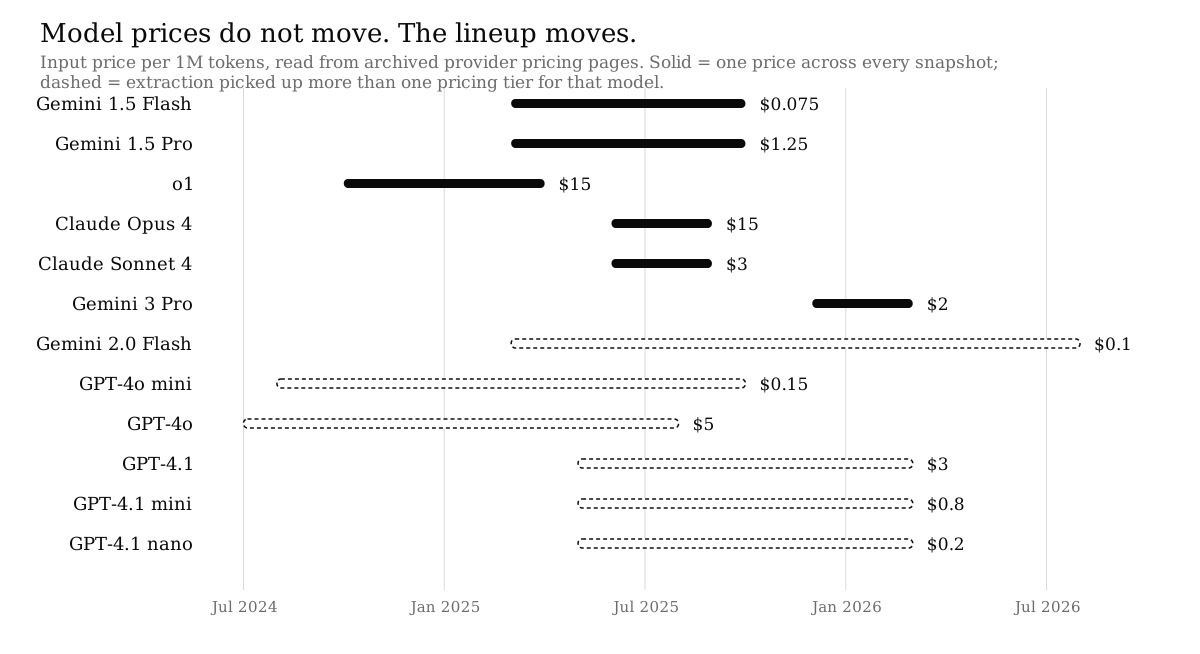
- Six of sixteen tracked model series held exactly one input price across every monthly snapshot — Gemini 1.5 Flash at $0.075 for eight months, Gemini 1.5 Pro at $1.25, o1 at $15, Claude Opus 4 at $15, Claude Sonnet 4 at $3, Gemini 3 Pro at $2.
- Across 141 monthly observations, 71.6% sit at their series' modal price. Most of the remaining variance is our extractor catching a batch or cached tier, not a price change.
- The cheapest listed model fell roughly 6.7x in two years — from GPT-3.5 Turbo at $0.50 per 1M input tokens in July 2024 to Gemini Flash at $0.075 — and every step of that came from a new model launching, not an existing one getting cheaper.
- Genuine in-place cuts do happen, and they are dramatic when they do. We caught two: o3 from $10.00 to $2.00, and GPT-5 from $1.25 to $0.25. Both 80%.
- The practical consequence: budgeting on "prices keep falling" is wrong at the model level. The model you picked will cost what it costs. Savings require migrating.
Individual LLM prices almost never change. Six of the sixteen model series we tracked held exactly one price across every monthly snapshot, and 71.6% of all observations sat at their series' modal price. The cost of AI genuinely does fall — the cheapest listed model dropped roughly 6.7x in two years — but every step of that came from a new model launching, not an existing one getting cheaper.
"Inference costs are collapsing" is one of the safest things you can say about AI. It is also hard to check, because every provider silently overwrites its own pricing page. Today's prices are everywhere. Last year's are nowhere.
So we went to the Wayback Machine and reconstructed them. 59 archived monthly snapshots of the pricing pages of OpenAI, Google and Anthropic, from January 2023 to August 2026, parsed into a per-model, per-month price series. The full dataset is available as CSV, and the scraper and parser are described in the method section below.
Six models that never changed price once
We tracked sixteen model series with at least four monthly observations each. Six of them show exactly one input price across every snapshot we hold — not a drift, not a rounding difference, the same number every month:
| Model | Provider | Input price | Months observed | Window |
|---|---|---|---|---|
| Gemini 1.5 Flash | $0.075 | 8 | Mar – Oct 2025 | |
| Gemini 1.5 Pro | $1.25 | 8 | Mar – Oct 2025 | |
| o1 | OpenAI | $15.00 | 6 | Oct 2024 – Apr 2025 |
| Claude Opus 4 | Anthropic | $15.00 | 4 | Jun – Sep 2025 |
| Claude Sonnet 4 | Anthropic | $3.00 | 4 | Jun – Sep 2025 |
| Gemini 3 Pro | $2.00 | 4 | Dec 2025 – Mar 2026 |
The ones that look like they moved mostly didn't
The other ten series return more than one value across their window, and the obvious reading is that the price changed. Look at the actual values and a different explanation appears.
GPT-4o returns three distinct prices: $2.50, $3.75 and $5.00. Those are not three prices over time. They are the Batch API rate, a cached-input rate, and the standard rate — all printed on the same page, in adjacent columns. Which one our parser caught depends on how that month's page was laid out. The same pattern explains GPT-4o mini ($0.15, $0.30, $0.60) and Gemini 2.0 Flash ($0.075, $0.10, $0.35).
This is a limitation of the extraction, and we are flagging it rather than dressing it up. But it cuts in a specific direction: it manufactures apparent price changes where none occurred. The true rate of price movement is lower than our raw series suggests, not higher. Where the extraction is unambiguous, the price is flat.
Real cuts happen, and they are large
Two series show a change too big to be tier confusion:
- o3 fell from $10.00 to $2.00 per 1M input tokens between May and August 2025 — an 80% cut.
- GPT-5 fell from $1.25 to $0.25 between September 2025 and March 2026 — also 80%.
So in-place price cuts are not unheard of. They are just rare, and when they arrive they are step changes rather than gradual erosion. Nothing in this dataset resembles a model whose price drifted down 5% a quarter.
Where the falling cost actually comes from
Track the cheapest model on any given month's page and the familiar story reappears. In July 2024 the cheapest listed model was GPT-3.5 Turbo at $0.50 per 1M input tokens. By 2026 it was Gemini Flash at $0.075. That is a 6.7x fall in the price floor in about two years.
Every step of that decline came from a new model appearing at a lower price point, not from an existing model being repriced. The floor drops when Flash ships, not when Pro gets cheaper. Providers hold list prices and compete by launching.
That distinction is invisible if you only look at market-level averages, and it is the whole story if you are the one paying the bill.
Method
- Snapshot discovery: the Wayback CDX API, one 200-status capture per calendar month per provider, from January 2023. Retrieved with the `id_` modifier so the archive returns the original response rather than a rewritten page.
- Providers: OpenAI (29 months), Google (25 months), Anthropic (5 months). 59 of 89 retrieved snapshots yielded usable token prices.
- Unit normalisation: early pages quote per 1,000 tokens and later ones per 1M, and some pages mix both. Units are resolved per price from its surrounding text, not per page, and every value is normalised to USD per 1M tokens.
- Non-token prices excluded: a price only counts if "token" or "MTok" appears near it, which keeps per-image, per-minute and per-request rates out of the series.
- Model association: prices are matched to model names by bounded proximity — each model's search window stops where the next model is mentioned — and a row is only accepted if it carries explicit input and output labels. Unlabelled rows are discarded rather than guessed at.
- Reported value: the modal price per series, not the mean, so a single misparsed month cannot shift a model's headline number.
- Validation: extraction was checked against independently known values, including GPT-4o at $5.00/$15.00, GPT-3.5 Turbo at $0.50/$1.50, o1 at $15/$60, Claude Opus 4 at $15/$75 and Claude Sonnet 4 at $3/$15.
Limitations
Anthropic coverage is thin — five months — and that is a data problem, not an Anthropic one. For most of the window their archived pricing URL captured the consumer subscription page (Pro, Team, Max) rather than API token pricing, so there were no token prices on it to extract. Treat the Anthropic rows as a sample, not a series.
Snapshots are point-in-time. A price that changed and changed back between two monthly captures is invisible to this method. Tier ambiguity remains unresolved for the ten non-constant series, as described above. Mistral and DeepSeek are not included in this cut. And the archive is not a complete record — one OpenAI month returned a 403 and is simply missing.
What to do with this if you are budgeting
The planning assumption that costs will fall under you is wrong at the level you actually operate at. If you build on a model today, that model will very probably cost the same in a year. The savings are real, but they are only available to teams that migrate — and migration has its own cost in evaluation, prompt rework and regression testing.
Which turns a finance question into an architecture one. Systems where the model sits behind a clean interface can capture the floor as it drops; systems with prompts and model quirks baked through them cannot, and end up paying 2023 prices in 2026. That is worth deciding deliberately at the start of an AI automation build rather than discovering it at renewal.
Frequently asked questions
Are LLM API prices actually falling?
The cheapest available model gets cheaper, but individual models mostly do not. Across 59 archived monthly pricing pages, six of sixteen tracked model series held exactly one price for their entire observed window, and 71.6% of all monthly observations sat at their series' modal price. The floor fell about 6.7x in two years — from $0.50 to $0.075 per 1M input tokens — entirely through new model launches.
Do AI providers ever cut the price of an existing model?
Rarely, but substantially when they do. This dataset caught two clear cases: o3 fell from $10.00 to $2.00 per 1M input tokens between May and August 2025, and GPT-5 fell from $1.25 to $0.25 between September 2025 and March 2026. Both were 80% cuts made in one step, not gradual reductions.
How can you find historical LLM API pricing?
Providers overwrite their pricing pages, so the current page is the only one they publish. Historical prices survive in the Internet Archive. Query the Wayback CDX API for captures of the pricing URL, fetch each with the id_ modifier to get the original response, and parse the prices out. The main pitfalls are unit changes — early pages quote per 1,000 tokens, later ones per 1M — and discount tiers printed alongside standard rates.
Why do the same model's prices appear to differ month to month?
Usually because the page lists several rates for one model. GPT-4o, for example, appears at $2.50, $3.75 and $5.00 on a single page — the Batch API rate, a cached-input rate and the standard rate. An automated reader can pick up whichever the layout puts first, which creates apparent price movement where the standard rate never changed.
Should I budget for AI costs to come down?
Not for the model you are on. Budget for it to cost what it costs today, and treat cheaper inference as something you have to go and get by migrating. Whether migration is cheap depends on your architecture: if the model sits behind a clean interface you can capture each new price floor, and if prompts and model-specific behaviour are spread through the codebase you probably cannot.
Related services
Related guides
Want a professional site without the agency invoice?
Tell us about your project below and we'll reply within 24 hours with a clear, fixed quote, no surprises.
Prefer WhatsApp or email?