[ Data ] · 8 min read
How Much Does a Developer Cost Per Hour in the UK vs the US?
A salary is not what a developer costs. Add payroll tax, pension, insurance and paid leave, then divide by the hours you actually get, and a UK developer runs $44.27-$66.84 per productive hour against $101.68-$147.73 in the US. The ranges do not overlap: London, the most expensive region in Britain, costs a third less than Houston, the cheapest major metro in America.
Key takeaways
- The UK and US ranges do not overlap at all. London, the most expensive UK region at $66.84 per productive hour, costs 66% of Houston, the cheapest US metro at $101.68.
- US employer on-costs run 43.0% of wages. UK on-costs run about 16%. The common assumption that European employment carries the heavier load is backwards.
- San Francisco reaches $147.73 per productive hour — 3.3x Wales at $44.27, for the same job title.
- A UK developer's on-cost percentage falls as salary rises, because the pension minimum is charged on a capped earnings band. London's 15.7% is lower than Wales' 16.1%.
- The government publishes all of this and blocks you from reading it. bls.gov returns HTTP 403 to any scripted request; api.bls.gov serves the same series without a key.
A software developer costs a UK employer between $44.27 and $66.84 per productive hour, and a US employer between $101.68 and $147.73 — once payroll tax, pension, insurance and paid leave are added and divided by the hours you actually get. The two ranges do not overlap. London, the most expensive region in Britain at $66.84, costs 66% of Houston, the cheapest major US metro at $101.68.
Every "how much does a developer cost" article quotes a salary, usually sourced from recruiter marketing. A salary is the smallest component of the answer and the only one anyone publishes.
What an employer actually spends is the salary plus payroll tax, pension, insurance and supplemental pay — and what it buys is not a year, because a meaningful share of the paid year is leave. The number that matters is total employer cost divided by productive hours, and it is not in any recruiter's report.
So we built it from wage microdata: 15 US metropolitan areas from the BLS Occupational Employment and Wage Statistics, 11 UK regions from the ONS Annual Survey of Hours and Earnings, loaded with the measured on-costs for each country. The full dataset is available as CSV.
The two countries do not overlap
This is the finding, and it was not the expected one. Not "the UK is somewhat cheaper on average." There is no region of Britain as expensive as the cheapest large American metro, and no American metro as cheap as the most expensive British region.
| Cheapest | Dearest | |
|---|---|---|
| United States | $101.68 — Houston, TX | $147.73 — San Francisco, CA |
| United Kingdom | $44.27 — Wales | $66.84 — London |
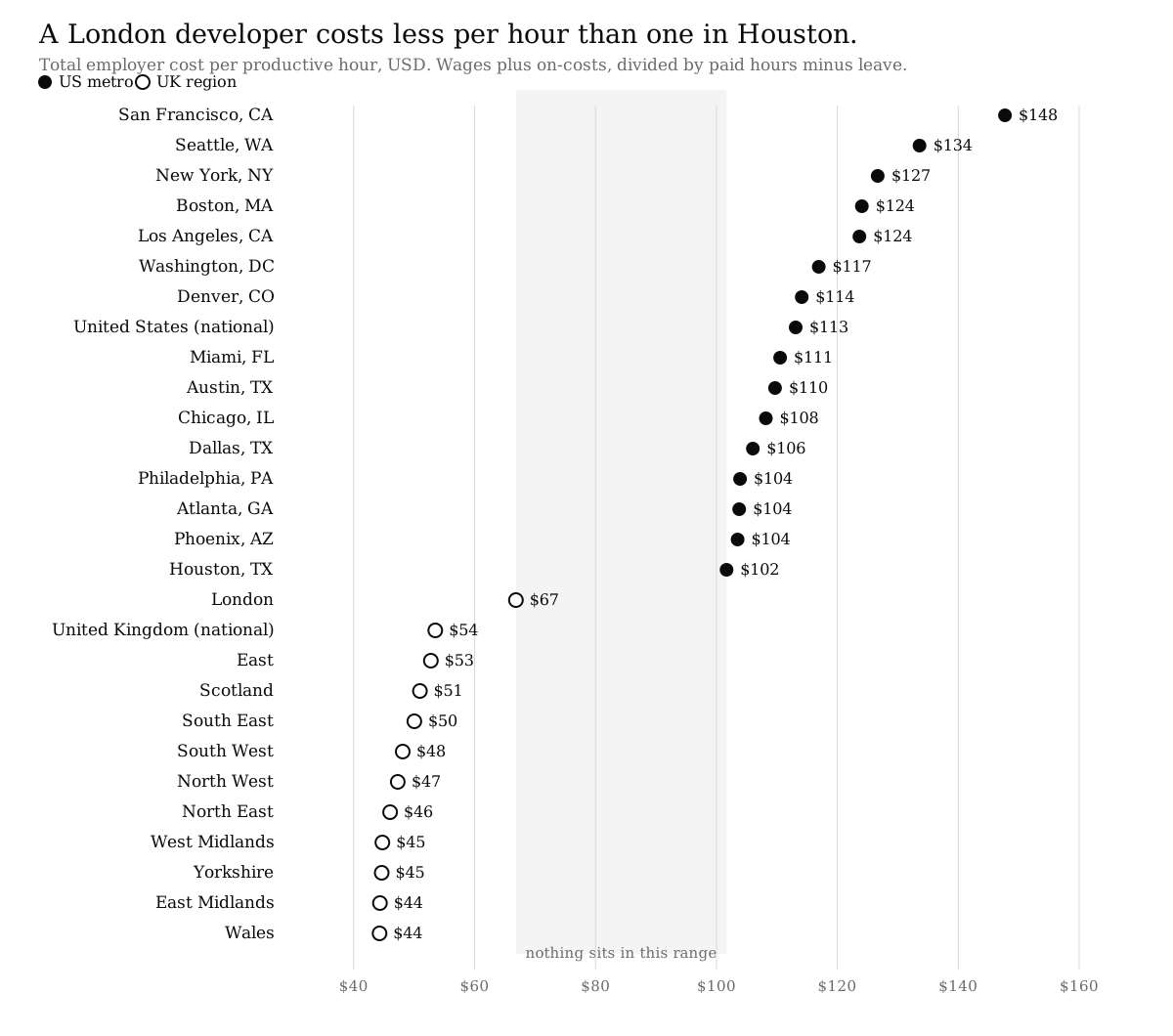
The internal spreads are almost identical — 1.45x across US metros, 1.51x across UK regions. Geography prices developers about as unevenly in both countries. The countries themselves are simply on different shelves.
American employment costs more, not less
The assumption we started with, and the one most people carry, is that European employment is the expensive one — heavy social contributions, long statutory leave, difficult dismissal. On the cost side that is the wrong way round.
| On-costs | What they are | |
|---|---|---|
| United States | 43.0% | Insurance, retirement, supplemental pay, legally required contributions |
| United Kingdom | 15.7 – 16.1% | Employer NI at 15% above £5,000, plus 3% pension on qualifying earnings |
The US figure is not an estimate. It is the ratio the BLS itself measures: $32.60 in wages and $14.01 in benefits per hour worked across private industry, first quarter of 2026. Employer-paid health insurance is most of the gap, and it has no British equivalent.
A detail that falls out of the arithmetic and runs against intuition: a UK developer's on-cost percentage goes down as their salary goes up. The 3% pension minimum is charged only on qualifying earnings between £6,240 and £50,270, so a developer earning well above the cap attracts proportionally less. London's on-costs are 15.7%; Wales' are 16.1%.
What this does and does not tell you about hiring offshore
The obvious use of a table like this is to argue that a cheaper rate elsewhere wins. It is worth being precise about what that argument actually requires, because the naive version of it is wrong.
An external rate is never the whole cost. Someone internal specifies the work, reviews it, and carries the context — and that person's time is charged at the loaded rates above. So the honest question is not "is the rate lower" but "how much internal time can the arrangement consume before the saving is gone?"
That has a clean answer. If an external rate is A and the in-house cost is C, the advantage disappears when internal management time reaches a fraction f = 1 − A/C of a full-time equivalent:
| External rate | vs US national ($113.11) | vs San Francisco ($147.73) | vs London ($66.84) |
|---|---|---|---|
| $25/hr | 78% | 83% | 63% |
| $40/hr | 65% | 73% | 40% |
| $60/hr | 47% | 59% | 10% |
| $80/hr | 29% | 46% | external costs more |
Read the table honestly and it cuts both ways. Against a San Francisco team, a $40/hr arrangement can absorb an enormous amount of management overhead and still win. Against London, a $60/hr arrangement is gone at ten per cent — barely half a day a week of someone's attention — and at $80/hr it is already more expensive than hiring.
The variable that decides it is not the rate. It is how much internal time the work consumes, which is a function of how well the scope is specified and how much context has to be transferred.
Method
- US wages: BLS Occupational Employment and Wage Statistics, 2025, occupation 15-1252 (Software Developers), 15 metropolitan areas plus national. 144 series requested, all returned data.
- US on-costs: BLS Employer Costs for Employee Compensation, 2026 Q1, private industry — $32.60 wages and $14.01 benefits per hour worked, a 43.0% load. Using ECEC avoids assembling a stack of assumptions about insurance and retirement.
- UK wages: ONS Annual Survey of Hours and Earnings 2025 provisional, Table 14 (national) and Table 15 (region), SOC 2020 code 2134, gross hourly pay, full-time.
- UK on-costs: employer National Insurance at 15% above the £5,000 secondary threshold for 2026-27, plus the 3% auto-enrolment pension minimum on qualifying earnings of £6,240–£50,270.
- Productive hours: US 1,872 (2,080 paid less 26 days' leave); UK 1,740 (1,950 paid less 28 days' statutory leave). The employer buys the paid year and uses part of it.
- Conversion at $1.27 to the pound. The UK figures stand on their own in sterling in the dataset.
Limitations
These are means, not offers. OEWS and ASHE describe the existing employed population, which skews toward established staff. A hiring manager competing for a specific senior candidate in a specific month will not pay the mean.
The UK figure is a statutory floor. There is no British equivalent of ECEC, so we used the minimum legal on-costs. Many UK employers pay above the pension minimum or offer private medical cover, both of which would narrow the transatlantic gap. The direction of that error is known: we are understating UK cost, not overstating it.
Leave assumptions differ by design. The UK figure uses the statutory 28 days; the US figure uses a typical 26 days of holidays and PTO, because the US has no statutory minimum at all. That is a real difference between the countries rather than a modelling choice, but it does move the per-hour numbers.
One cell is missing: ONS suppresses web developer figures for some regions, and BLS suppressed web developer wages for Miami. Software developers are complete for every location shown.
A note on how hard this was to read
This is public data that the public cannot easily get. `bls.gov` and `download.bls.gov` return HTTP 403 to any scripted request — which is very likely why the developer-cost articles all quote recruiter marketing instead of the wage statistics. The API at `api.bls.gov` serves the same OEWS series, metro level included, with no key required.
The ONS side is open but awkward: the current tables still live under a URL containing `soc2010` while carrying SOC 2020 codes, and each release is a zip of twenty-odd workbooks with the useful sheet named for an employee subgroup. None of this is secret. It is just tedious enough that almost nobody does it.
If you are making this decision
The number to carry out of this is not a rate. It is that the comparison is decided by specification quality, not by geography. Work that is well-scoped survives being done anywhere; work that requires constant clarification consumes internal time at $100 or more an hour, and that meter runs whichever side of the Atlantic the developer sits on.
Which makes it worth being honest about the shape of the work before choosing who does it. A defined build with a clear boundary is a different proposition from an open-ended stream of changes, and it is the kind of thing worth settling at the start of a custom software engagement rather than discovering three months in.
Frequently asked questions
How much does a software developer cost per hour in the UK?
Between $44.27 and $66.84 per productive hour depending on region, once employer National Insurance, pension and leave are included. That is roughly £34.85 in Wales to £52.63 in London. Gross hourly pay itself ranges from £26.79 in Wales to £40.58 in London, per ONS ASHE 2025 provisional data for SOC 2134.
Is it cheaper to hire developers in the UK or the US?
The UK, decisively, and the ranges do not overlap. London is the most expensive UK region at $66.84 per productive hour and still costs 66% of Houston, the cheapest large US metro at $101.68. San Francisco reaches $147.73, more than three times the cheapest UK region.
What are employer on-costs for a developer?
In the US, 43.0% above gross wages, per the BLS Employer Costs for Employee Compensation survey — private industry pays $32.60 in wages and $14.01 in benefits per hour worked, mostly health insurance and retirement. In the UK, about 16%: employer National Insurance at 15% above a £5,000 threshold, plus a 3% pension minimum on qualifying earnings.
Why do UK employer costs fall as a percentage when salary rises?
Because the auto-enrolment pension minimum is charged only on qualifying earnings between £6,240 and £50,270. A developer earning well above that cap attracts the same absolute pension contribution as one at the cap, so it shrinks as a share of salary. London's on-costs work out at 15.7% against Wales' 16.1%, despite London salaries being roughly 50% higher.
When does hiring in-house beat using an agency?
It depends on how much internal management time the arrangement consumes, not on the headline rate. If the external rate is A and your in-house cost per productive hour is C, the saving disappears once internal oversight reaches 1 − A/C of a full-time equivalent. Against a London in-house cost of $66.84, a $60/hr external rate is gone at about 10% of one person's time; against San Francisco's $147.73, a $40/hr rate survives up to 73%.
Related services
Related guides
Want a professional site without the agency invoice?
Tell us about your project below and we'll reply within 24 hours with a clear, fixed quote, no surprises.
Prefer WhatsApp or email?