[ Data ] · 7 min read
Which Industries Are Adopting AI Fastest? (US Census Data, 17 Sectors)
Construction is adopting AI faster than any other US industry — 7.4% to 14.9% in nine months, the strongest signal in the dataset. Information, the highest adopter at 45.0%, has plateaued. Drawn from the US Census survey of 1.2 million businesses, with every change tested against its own standard errors.
Key takeaways
- Construction nearly doubled its AI use in nine months, from 7.4% to 14.9% — the strongest signal in the dataset at 6.7 standard errors.
- Information is the highest-adoption sector at 45.0%, and its change is not distinguishable from zero. Neither is educational services'. The two most AI-native sectors have plateaued.
- Eleven of seventeen sectors grew significantly. Not one declined. The apparent falls in utilities and accommodation are noise — utilities' change carries a ±6.3pp standard error.
- Multi-sector companies moved furthest of all, 24.2% to 33.3%, consistent with the Census finding that larger firms adopt faster.
- The US stopped measuring AI adoption for six weeks in late 2025 because of the federal funding lapse. Three survey cycles are simply missing.
Construction is adopting AI faster than any other US industry. It nearly doubled in nine months, from 7.4% to 14.9% of businesses — the clearest signal in the US Census Bureau's data, at 6.7 standard errors. Meanwhile Information, still the highest-adoption sector at 45.0%, has stopped growing measurably. Eleven of seventeen sectors grew over the period. None declined.
Nearly every AI adoption statistic in circulation comes from a vendor survey of a few hundred executives who agreed to answer a vendor survey. The sample is self-selected, the sponsor sells AI, and the number is almost always large.
The US Census Bureau runs a different instrument. The Business Trends and Outlook Survey samples roughly 1.2 million businesses, splits them across six panels, collects every fortnight, and asks a plain question: "in the last two weeks, did this business use Artificial Intelligence in any of its business functions?" It publishes standard errors alongside every estimate.
It is barely mined, because it arrives as multi-tab spreadsheets with no documentation of which tab holds what. We pulled the sector series and tested every movement against its own error bars. The full dataset is available as CSV.
Eleven sectors grew. None declined.
Between the cycle collected 17–30 November 2025 and the one collected 27 July – 9 August 2026, eleven of seventeen sectors moved by more than 1.96 standard errors. Six did not move detectably. Nothing went backwards.
| Sector | Nov 2025 | Aug 2026 | Change | Significant |
|---|---|---|---|---|
| Multi-sector companies | 24.2% | 33.3% | +9.1pp | yes |
| Construction | 7.4% | 14.9% | +7.5pp | yes |
| Real estate and leasing | 21.0% | 28.0% | +7.0pp | yes |
| Finance and insurance | 29.9% | 36.8% | +6.9pp | yes |
| Manufacturing | 12.7% | 19.3% | +6.6pp | yes |
| Administrative and support | 15.3% | 21.2% | +5.9pp | yes |
| Health care and social assistance | 18.1% | 23.5% | +5.4pp | yes |
| Wholesale trade | 12.6% | 17.9% | +5.3pp | yes |
| Educational services | 31.9% | 36.7% | +4.8pp | no |
| Professional and technical services | 34.7% | 39.3% | +4.6pp | yes |
| Information | 41.0% | 45.0% | +4.0pp | no |
| Transportation and warehousing | 7.9% | 11.2% | +3.3pp | yes |
| Retail trade | 12.5% | 15.5% | +3.0pp | yes |
| Other services | 10.2% | 11.3% | +1.1pp | no |
| Arts, entertainment and recreation | 18.0% | 18.6% | +0.6pp | no |
| Utilities | 13.1% | 12.6% | −0.5pp | no |
| Accommodation and food services | 8.9% | 8.3% | −0.6pp | no |
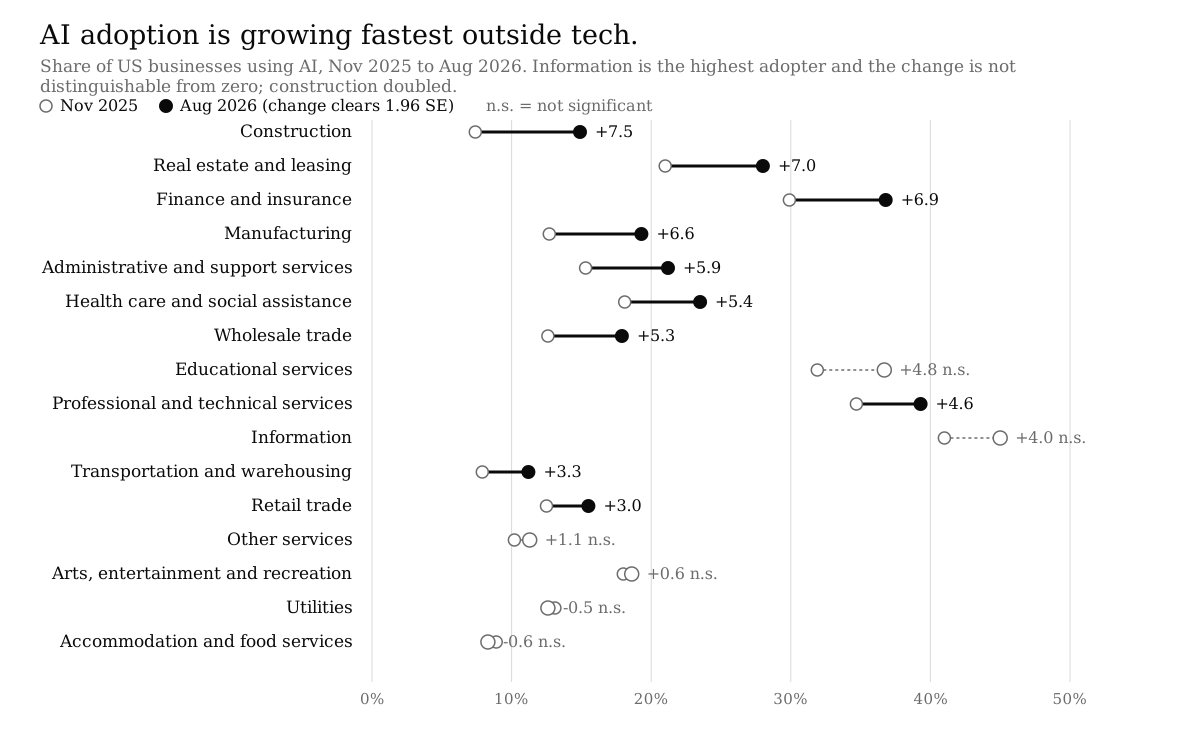
The interesting number is the one that did not move
Information is the highest-adoption sector in the survey at 45.0%. Its nine-month change of +4.0pp does not clear its own standard errors. Educational services, second-highest of the conventional sectors at 36.7%, is in the same position.
Meanwhile construction went from 7.4% to 14.9%. Manufacturing added 6.6 points. Wholesale trade added 5.3. Transportation added 3.3 from a very low base.
The shape of that is a diffusion curve doing exactly what diffusion curves do. The sectors that adopted first are approaching their ceiling; the growth has moved to the sectors that had not started. Anyone still describing AI adoption as a technology-sector story is describing 2023.
This matters commercially in a specific way. If you sell into information or professional services, you are selling into a market that is largely already using something, and the conversation is replacement. If you sell into construction, manufacturing or wholesale, the market is still in first-purchase, and it is moving quickly.
What the standard errors delete
Read the raw table without error bars and there are two obvious headlines: utilities and accommodation both went backwards. Both are noise.
Utilities' change of −0.5pp carries a standard error of about ±6.3pp. The sector has few enough businesses that the survey cannot resolve a movement of that size. Accommodation's −0.6pp is likewise well inside its error. Reporting either as a decline would be inventing a finding.
We treated the two cycles as independent when combining their errors. Because the panels overlap, the true error is somewhat smaller than that, so the test is conservative: it makes significance harder to claim, not easier.
Six weeks when nobody was counting
The published AI series has a hole in it. Cycles 202521, 202522 and 202523 — covering 6 October to 16 November 2025 — do not exist, because of the federal funding lapse. Collection stopped.
It is worth stating plainly because it is the sort of gap that gets quietly interpolated over. During a period of rapid change in business AI use, the United States has no measurement of it for six weeks. Our window starts immediately after that gap for exactly this reason.
Method
- Source: US Census Bureau Business Trends and Outlook Survey, `Sector.xlsx` and `National.xlsx` from the BTOS download directory, retrieved 22 August 2026.
- Question 7: "In the last two weeks, did this business use Artificial Intelligence (AI) in any of its business functions?" Percentages are the share answering Yes.
- Window: cycle 202524 (collected 17–30 November 2025) to cycle 202616 (collected 27 July – 9 August 2026).
- Significance: change divided by the combined standard error of the two estimates, treating them as independent, tested against 1.96.
- Suppressed cells are carried through as missing rather than as zero.
- "Multi-sector companies" is the Census category for firms operating across several sectors — not an all-sectors total.
Limitations
This is a nine-month window, not a year. The AI question is only populated in the published series from cycle 202524 onward, so a twelve-month comparison is not available from this file, and we would rather report nine months honestly than stitch together sources measuring different things.
"Using AI" is self-reported and undefined in scope. A business answering yes may be running a large deployment or may have a member of staff using a chatbot. The question captures breadth of adoption, not depth of it, and the trend is more reliable than the level.
This is the United States only. The UK's counterpart, the ONS Business Insights and Conditions Survey, asks about AI less consistently, so a like-for-like transatlantic cut is not available from public data at this granularity.
The line worth taking to a board
Most AI business cases are argued from vendor projections. This one can be argued from a government instrument with a 1.2-million-business sample: your competitors in construction went from 7.4% to 14.9% in nine months. In manufacturing, 12.7% to 19.3%. In wholesale, 12.6% to 17.9%.
Those are the sectors where adoption is still a competitive differentiator rather than table stakes, and where the window in which it is one is visibly closing. The useful question for a business in one of them is not whether to adopt but which process to start with — which is the first thing worth settling in any AI automation engagement, before anything gets built. For construction, the sector moving fastest here, we have written that out as five workflows worth automating and the ones that are not.
Frequently asked questions
Which industry is adopting AI fastest?
Construction, which nearly doubled from 7.4% to 14.9% between November 2025 and August 2026 — the strongest signal in the dataset at 6.7 standard errors. Real estate, finance and insurance, and manufacturing all added between 6.6 and 7.0 percentage points over the same period.
What percentage of US businesses use AI?
About 21.8% as of the cycle collected 27 July to 9 August 2026, per the Census Bureau's Business Trends and Outlook Survey. That is up from roughly 17.3% in late November 2025. Adoption varies enormously by sector, from 45.0% in Information to 8.3% in accommodation and food services.
Is AI adoption slowing down in the technology sector?
It has stopped growing measurably. Information is the highest-adoption sector at 45.0%, but its 4.0-point rise over nine months does not clear its own standard errors, so it cannot be distinguished from no change. Educational services is in the same position. This is what a diffusion curve looks like when early adopters approach saturation and growth moves to later sectors.
Where does US government AI adoption data come from?
The Census Bureau's Business Trends and Outlook Survey, which samples about 1.2 million businesses across six panels and collects fortnightly. Data is published free at census.gov/hfp/btos/data as spreadsheets covering national, sector, subsector and state cuts, with standard errors alongside every estimate. It is a much larger and less self-selected sample than the vendor surveys most AI statistics come from.
Did any industry reduce its AI use?
No. Utilities and accommodation and food services both show small negative changes, but neither is statistically distinguishable from zero — utilities' change carries a standard error of roughly ±6.3 percentage points, far wider than the 0.5-point move itself. Across all seventeen sectors, eleven grew significantly and none declined significantly.
Related services
Related guides
Want a professional site without the agency invoice?
Tell us about your project below and we'll reply within 24 hours with a clear, fixed quote, no surprises.
Prefer WhatsApp or email?