[ Analysis ] · 10 min read
Pakistanware Ransomware: What the Evidence Actually Shows
A locker calling itself pakistanware started encrypting home users' files on the eve of Pakistan's Independence Day 2026. It signs its own ransom note "by APT36". Researchers are not convinced, and the reasons why are worth understanding.
Key takeaways
- Pakistanware encrypts files with a .pakistan extension and replaces the desktop wallpaper with a Pakistan flag and a ransom note, first reported detonating at 22:05 on Thursday 13 August 2026, the eve of Pakistan's Independence Day.
- The note names APT36 (Transparent Tribe) as its author. Multiple researchers consider that attribution premature, because a state-aligned espionage group announcing itself on a victim's wallpaper works against everything espionage is for.
- There is no ransom demand, no wallet address, and no contact channel in the note, which means this behaves like destructive propaganda rather than an extortion business.
- Reports that it survived a Windows reinstall are most plausibly reinfection from compromised install media or unwiped partitions. No evidence of BIOS or UEFI firmware tampering has been presented, and r/antivirus moderators are actively removing advice to replace hardware.
On the night of 13 August 2026, home users across South Asia watched their desktop wallpaper get replaced by a green Pakistan flag and a short block of text announcing that their files were encrypted. The malware names itself pakistanware. It appends a .pakistan extension to encrypted files, and it signs its own ransom note with the name of one of the region's best known state-aligned threat groups: APT36, also tracked as Transparent Tribe.
The timing was not incidental. The first widely shared screenshot carries a visible timestamp of 22:05 on Thursday 13 August 2026, roughly two hours before Pakistan's Independence Day began. At the time of writing, no antivirus vendor has published a formal analysis, so almost everything known publicly comes from victim screenshots, a VirusTotal submission, and discussion among researchers on Reddit. This guide sets out what the evidence supports, what it does not, and what the disagreement is actually about.
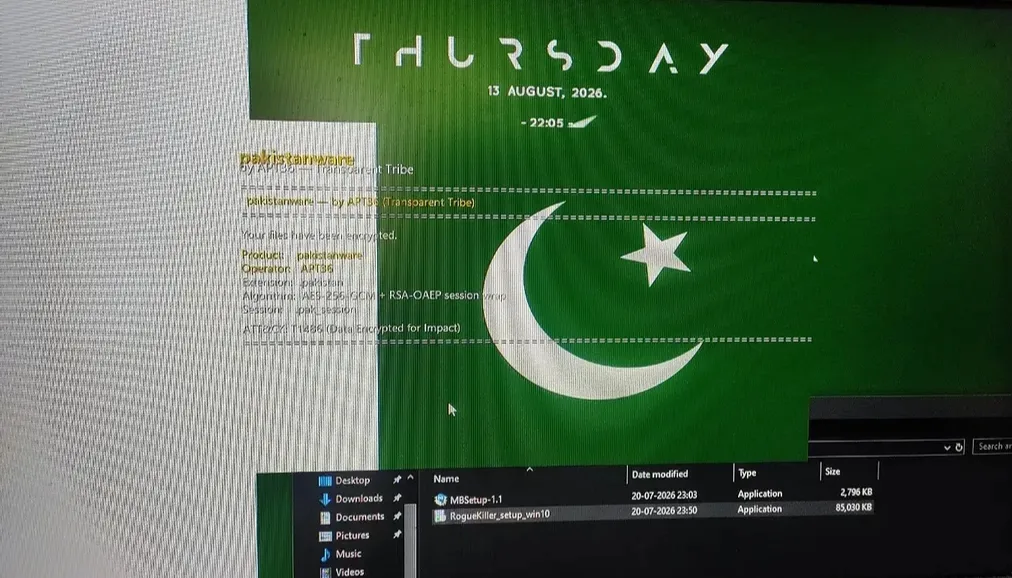
What the ransom note claims
The note is unusually structured for a ransomware splash screen. Rather than the usual payment instructions, it reads like a specification sheet, listing its own fields in a fixed-width layout.
| Field | Value stated in the note |
|---|---|
| Product | pakistanware |
| Operator | APT36 |
| Extension | .pakistan |
| Algorithm | AES-256-GCM + RSA-OAEP session wrap |
| Session | .pak_session |
| ATT&CK | T1486 (Data Encrypted for Impact) |
The stated cryptography describes a standard hybrid scheme, and it is worth understanding what it would mean if the implementation matches the claim. AES-256-GCM is authenticated symmetric encryption, fast enough to encrypt a full disk of documents in minutes. RSA-OAEP session wrap means the per-victim AES key is itself encrypted with the operator's RSA public key, so only whoever holds the matching private key can unwrap it. Done correctly, that combination leaves no route to recovery without the operator's key.
The important word there is correctly. Plenty of amateur lockers advertise textbook cryptography and then undermine it in implementation: hardcoding the symmetric key in the binary, seeding the random number generator with the system clock, leaving the session key in memory or on disk, or encrypting only the first few kilobytes of each file. Those mistakes are exactly why free decryptors exist for a long list of ransomware families. Until someone reverse engineers a pakistanware sample, the note's crypto claim tells you what the author intended, and nothing about whether they achieved it.
What has actually been confirmed
Stripped of speculation, the confirmed public record as of 17 August 2026 is thin:
- A sample was submitted to VirusTotal (SHA-256 beginning b15f854c) and returns a variety of generic detections, meaning engines are flagging it on broad heuristics rather than a named family signature. That pattern is typical of malware too new or too low-volume to have earned dedicated detection logic.
- Victim reports are scattered across Instagram, X, and Reddit, concentrated on the same date. The primary Reddit thread on r/antivirus drew 776 upvotes and 217 comments within days.
- Moderators reviewing the evidence stated there are no indications this is a massive, ongoing campaign, which distinguishes it from a coordinated operation against a sector or an organisation.
- No evidence of zero-day exploitation has been presented, and no evidence of BIOS or UEFI firmware modification has been presented.
- Affected machines appear to belong to individual home users and small content creators, not government, military, or defence organisations.
That last point carries more weight than it first appears, and it feeds directly into the argument over who wrote this.
The attribution fight: is this really APT36?
APT36 is real, and it is well documented. Tracked by MITRE as G0134 and known variously as Transparent Tribe, COPPER FIELDSTONE, Mythic Leopard, and ProjectM, it is a Pakistan-aligned group active since at least 2013. Its documented work is espionage: stealing documents and credentials from Indian government, diplomatic, military, and education targets using spear-phishing, ClickFix-style social engineering, and remote access trojans such as Crimson RAT. Acronis recently documented a further espionage cluster, PatchCord, against Afghan telecom and South Asian critical infrastructure. Because that history is genuine, a ransom note bearing the group's name carries immediate weight with a general audience. Both sides of the resulting argument deserve a fair hearing.
The case that APT36 is involved
The strongest argument is context. APT36 is Pakistan-aligned, the payload is branded with Pakistani nationalist imagery, and it fired on Pakistan's Independence Day. There is precedent for holiday-timed attacks in the region: in August 2025, the Blue Locker ransomware campaign against Pakistan Petroleum Limited was timed around 14 August 2025, prompting Pakistan's national CERT to issue advisories to 39 ministries and institutions. Symbolic dates demonstrably matter to actors operating in this space.
There is also a plausible mechanism for how a cheap branded locker could come out of this ecosystem. In March 2026, Bitdefender documented what it named "vibeware", linking it with medium confidence to APT36: an AI-assisted development model in which large language models rewrite equivalent malicious logic across Nim, Zig, Crystal, Rust, and Go, releasing disposable variants at near-daily cadence to reset detection baselines. If producing throwaway malware has become that cheap, producing a throwaway locker is trivially cheap too.
The case that the attribution is false
The counterargument is considerably stronger, and it comes from people who analyse this professionally. Aryeh Goretsky, an ESET Distinguished Researcher and r/antivirus moderator, laid out the objection directly in the thread: it would be highly unusual for a sophisticated adversary that normally runs targeted operations to switch to indiscriminate public attacks, identify itself through binary metadata and desktop wallpaper, and helpfully document how it encrypted the files.
Break that down and there are four separate problems with taking the note at face value:
- Espionage depends on going unnoticed. A group whose entire value comes from quiet, long-term access to Indian government networks gains nothing and loses much by painting its codename across civilian desktops.
- Real operators do not cite ATT&CK against themselves. T1486 is a label from MITRE's framework, the taxonomy defenders use to classify attacks. Printing it in your own ransom note is a stylistic flourish aimed at whoever screenshots it.
- There is no ransom demand. No wallet address, no victim ID, no contact channel, no payment portal. Extortion malware always includes the mechanism that makes it profitable. Its absence means this is not an extortion operation at all, which makes the "ransomware" label technically incomplete: it encrypts, but it never tries to sell anything back.
- The victim profile is wrong. The people posting screenshots are home users and small creators. That is the opposite of APT36's documented targeting, and it is what you would expect from opportunistic distribution such as pirated software, cracked installers, or game mods.
Taken together, the likeliest reading is a false flag: hacktivists or low-skill actors borrowing a recognisable APT name for credibility and impact. This is common. A famous name in a ransom note costs nothing to type and buys instant press coverage. As Goretsky put it, attributing this to Transparent Tribe may be premature at this time. That phrasing is deliberate, and it is the correct posture: the claim is unproven rather than disproven, and it would take sample analysis or infrastructure overlap to settle either way.
"It survived a Windows reinstall"
The detail that pushed this story beyond a handful of screenshots was a victim reporting that the infection persisted after reinstalling Windows from a USB drive. That claim is what sent parts of the thread toward firmware implants and motherboard replacement. There are far more ordinary explanations, and Goretsky named the three that matter.
| Explanation | What actually happened | How to tell |
|---|---|---|
| Encrypted files were never removed | Reinstalling Windows to C: leaves other partitions and external drives untouched. The .pakistan files sit there afterwards, looking like the malware came back. | Files are encrypted but nothing new is being encrypted, and no new processes appear. |
| Compromised install media | The USB used to reinstall was prepared on an already-infected machine and carried the payload into the clean install. | Reinfection happens immediately on first boot, before any downloads. |
| Reintroduced by the user | The dropper came back through a restored backup, a synced cloud folder, or by re-running whatever installer caused the first infection. | Reinfection follows a restore or a specific download. |
The second explanation deserves attention, because there is documented precedent for this exact actor. Kaspersky's analysis of Transparent Tribe describes a USBWorm component bundled with Crimson RAT that monitors removable media, catalogues the directories on each device, and writes copies of itself into the drive root disguised using those real directory names. A USB stick prepared on an infected machine is a genuine reinfection vector, and it explains the reported symptom without requiring anything exotic.
Why the firmware theory needs evidence
By 17 August 2026, r/antivirus moderators were removing comments recommending that people reflash their BIOS, replace motherboard chips, or throw away keyboards, mice, and monitors. Their stated reason: no evidence has been presented that this malware does anything to a computer's hardware. UEFI bootkits do exist, and a small number have been found in the wild, but they are rare, expensive to develop, and normally reserved for high-value targets. Diagnosing one requires a firmware dump and analysis, not inference from a machine that got reinfected.
The practical harm of the panic is real. Someone convinced their motherboard is compromised spends money replacing working hardware, and they still get reinfected, because the actual cause was the USB stick sitting on the desk next to them.
What to do if you are affected
- Preserve a copy of the encrypted files before doing anything else. If a decryptor is released later, or a flaw is found in the implementation, those files become recoverable. Deleting them forecloses that option permanently.
- Do not pay anything. There is no payment mechanism in the note, so any "decryption service" offering to help with pakistanware is a second scam layered on the first.
- Disconnect and quarantine every USB drive that touched the infected machine. Do not use one of them to build your reinstall media.
- Build install media on a machine you know is clean, and wipe all partitions during the reinstall rather than only the Windows partition.
- Change passwords from a different device, since victim reports describe a remote access trojan alongside the encryption, and any credential stored or typed on the machine should be considered exposed.
- Submit a sample to VirusTotal and report it to your national CERT. The reason there is no vendor analysis yet is partly that too few samples have reached researchers.
What this means for businesses
Pakistanware itself is unlikely to be a serious business threat. It is opportunistic, loud, and appears to be spreading through consumer channels. The pattern behind it is the part worth taking seriously: cheap malware production is accelerating, symbolic dates draw activity, and the branding on the screen is now among the least reliable pieces of evidence in an incident.
The defences that make this class of incident survivable are unglamorous and well understood. Offline backups that are tested by restoring from them, rather than assumed to work. Software installed from vendor sources rather than cracked bundles. Removable media treated as untrusted. Credentials that are unique per service, so one compromised machine does not become a compromised business. If your site or platform is part of how your business earns, our guide on what WordPress security services actually cover explains where those responsibilities usually sit, and what ongoing maintenance includes covers the backup and update discipline that decides whether an incident is an afternoon or a fortnight.
One closing note on reading incidents like this. The single most useful habit is separating what a threat actor claims from what has been demonstrated. In this case the malware claimed a famous author, a specific cryptographic scheme, and, by implication through the panic it caused, a capability to survive a reinstall. As of this writing, all three remain claims. Treating them as findings is how bad advice spreads, and it is why the moderators of a subreddit ended up deleting recommendations for people to buy new motherboards.
Frequently asked questions
What is pakistanware ransomware?
Pakistanware is malware first reported on 13 August 2026 that encrypts files with a .pakistan extension and replaces the desktop wallpaper with a Pakistan flag and a ransom note. The note claims the files were encrypted with AES-256-GCM and an RSA-OAEP wrapped session key. Unusually, it contains no ransom demand, wallet address, or contact channel.
Was pakistanware really made by APT36 or Transparent Tribe?
The ransom note says so, but researchers consider the attribution premature. APT36 is a Pakistan-aligned espionage group that runs targeted, quiet operations against government and military targets. Announcing itself on civilian desktops, citing MITRE ATT&CK against itself, and hitting home users all run contrary to that pattern. A false flag using a recognisable name is the more likely explanation.
Can pakistanware survive a Windows reinstall?
There is no evidence it persists through a clean reinstall by itself. Reports of survival are best explained by encrypted files remaining on partitions that were never wiped, by USB install media that was already infected, or by the malware being reintroduced through a backup or download. Transparent Tribe has a documented USBWorm component that infects removable drives, which makes compromised install media a realistic vector.
Does pakistanware infect BIOS or UEFI firmware?
No evidence of firmware modification has been presented. Moderators on r/antivirus began removing posts recommending BIOS reflashing or hardware replacement on 17 August 2026, stating there is no evidence the malware affects hardware. Replacing motherboards or peripherals is not a supported response to this infection.
Can pakistanware encrypted files be decrypted?
No decryptor exists at the time of writing, and no vendor has published an analysis. Keep an encrypted copy of your files regardless. Amateur ransomware frequently contains implementation flaws such as hardcoded or predictable keys, and decryptors are sometimes released months later once a sample has been reverse engineered.
Related services
Related guides
Want a professional site without the agency invoice?
Tell us about your project below and we'll reply within 24 hours with a clear, fixed quote, no surprises.
Prefer WhatsApp or email?